
Each director's conduct is judged individually, but every director owes the same duties, and "I left it to the others" is not a defence. A director who took no part in running the company is still responsible for knowing its financial position, for the decision to keep trading, and for making sure proper records were kept. Wrongful trading, misfeasance and disqualification are assessed director by director, so an inactive director's exposure depends on what they knew or should have known and what they did about it, not on their job title.
The duties are the same for everyone
The statutory duties, including the duty to act in the company's interests and, once insolvency looms, to have regard to the creditors' interests, apply to every director: executive, non-executive, nominal, a spouse added to the board for convenience, and a shadow director who was never appointed but whose instructions the board followed. The standard is that of a reasonably diligent person with the knowledge, skill and experience reasonably expected of someone in that role, as well as the director's actual knowledge.
Where the differences lie
- What each director knew. A finance director who saw the management accounts is judged on them; a director who never asked to see them is judged on the fact that they should have.
- What each director did. Minuted objections, insistence on advice, refusal to approve a transaction, and resignation after proper protest all count in a director's favour.
- Personal benefit. A director who took money out, or whose connected company received a preference, is in a different position from one who did not.
- Guarantees are personal and depend on who signed what.
Disqualification
Reports to the Insolvency Service cover all the directors, and the Service decides about each. Inactive directors are disqualified, for shorter periods, where they abdicated responsibility entirely; they are not where they can show they monitored the position and acted when they learned of it.
What to do now
- Ask for the accounts, the bank statements and the creditor list today, and keep a record that you asked.
- Insist on a board meeting and minute it: the position, the advice to be taken, the decisions.
- If you disagree with what the other directors are doing, say so in writing, and take your own advice.
- Do not resign as a reflex; see can I resign?
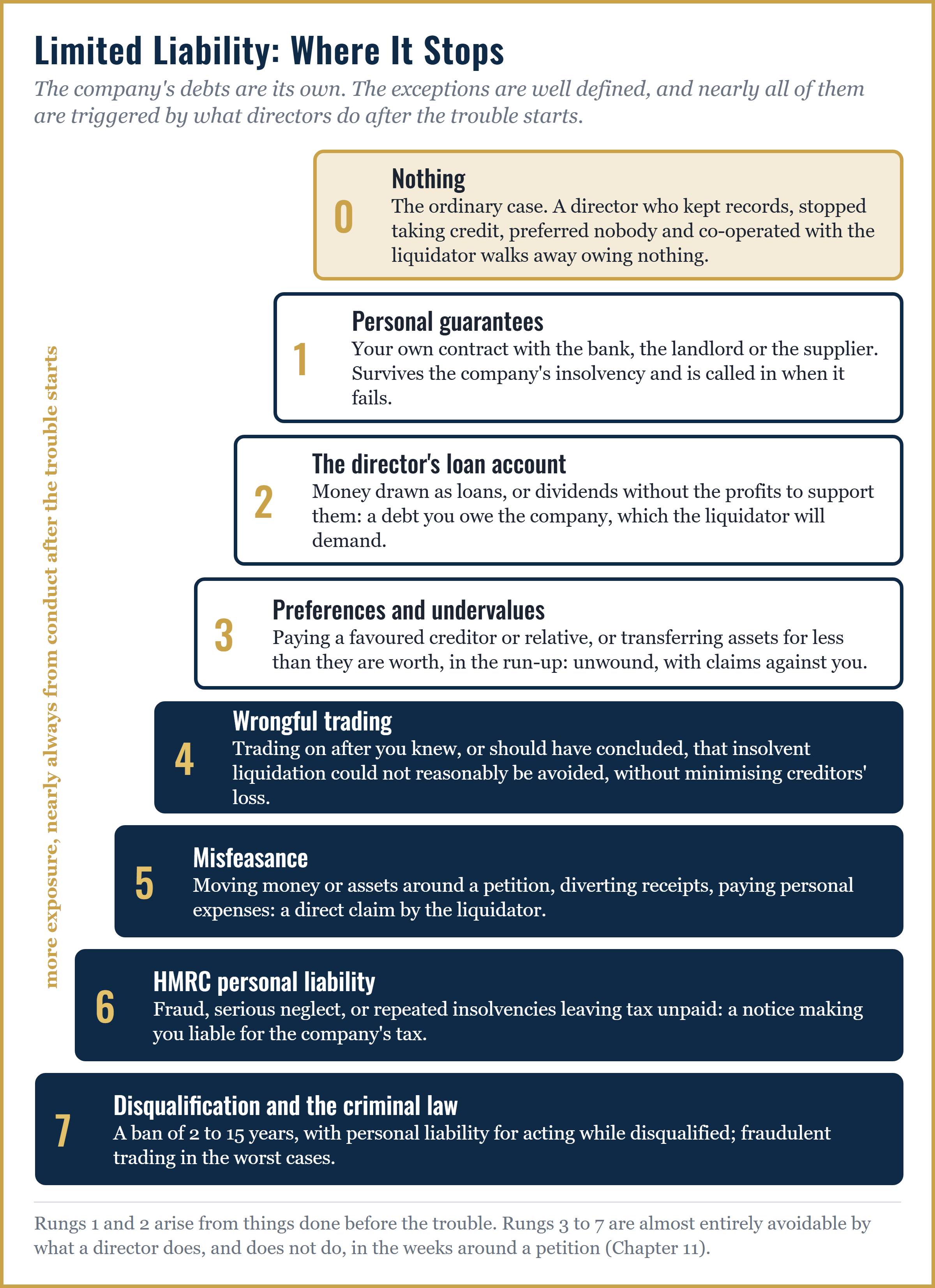
From The Winding-Up Petition Handbook, free for directors.
Where this is covered in more depth
The director's personal position and the glossary entry for wrongful trading.
Free initial consultation for directors facing a winding-up petition. Call 07361 999123, text DIRAID to 82228, or request a call back.
Your free call is with a Solicitor. Have the petition to hand if you can.
Text DIRAID to 82228and we will call you back
Or call us on 07361 999123
First consultation free · No obligation · Nothing to lose