
Often yes, but it depends on why the first petition ended. A debt that was paid cannot found a new petition, and a debt the court accepted was genuinely disputed should not be put back before the winding-up court. A petition dismissed for a procedural failing, or withdrawn under a payment deal the company then broke, can usually be followed by a fresh one, and other creditors are never barred. Directors also ask "can HMRC issue another winding-up petition?", "can a winding-up petition be reissued?" and "is there a waiting period before a creditor can petition again?". There is no fixed waiting period; what matters is the reason the first petition ended and whether the company still owes money it cannot pay.
Facing a second petition, or worried about one? Free initial consultation with a Solicitor: call 07361 999123 or text DIRAID to 82228.
Your free call is with a Solicitor. Have the petition to hand if you can.
Text DIRAID to 82228and we will call you back
Or call us on 07361 999123
First consultation free · No obligation · Nothing to lose
Why the reason for dismissal matters
A dismissal or withdrawal ends that petition. It does not, by itself, wipe out the debt or decide whether the company owes it. So the question a director needs answered is: what did the first petition end on? The table sets out the usual position.
| How the first petition ended | Can the same creditor petition again? |
|---|---|
| The debt was paid in full and the petition dismissed or withdrawn | Not on that debt, which no longer exists. A new unpaid debt can found a new petition. |
| Dismissed because the debt was disputed on genuine and substantial grounds | Not on the same disputed debt. The creditor should sue in the ordinary courts; if it wins judgment and is not paid, it can petition on the judgment. |
| Dismissed for a procedural failing (defective service, late or missing advertisement, no certificate of compliance, petitioner not attending) | Usually yes, with a fresh petition and a fresh court fee and deposit, though the court can be critical of repeated defective petitions. |
| Withdrawn or dismissed because the company agreed instalments | Yes, if the company misses a payment, and many agreements say so expressly. |
| Dismissed after the company proved it was solvent and the debt was paid or secured | Not on that debt; the creditor would need a new unpaid debt and fresh evidence of inability to pay. |
Paid debts
If the company paid the petition debt and the petitioner's costs, and the petition was withdrawn with the court's permission or dismissed at the hearing, that debt is gone. The creditor has nothing left to petition on. If the same creditor is owed more money later (HMRC with a new quarter's VAT or PAYE, for example) it can present a new petition on the new debt in the usual way. Paying one petition does not protect the company from the next if the arrears keep building.
Disputed debts
The winding-up court is not the place to decide a genuine dispute about whether money is owed. Where the company shows that the debt is disputed on genuine and substantial grounds, the court will usually dismiss the petition, and the petitioner is often ordered to pay the company's costs. Presenting a fresh petition on the same disputed debt is likely to be treated as an abuse of the court's process, and the company can apply for an injunction to restrain it, or to restrain its advertisement. See injunction to restrain a winding-up petition.
What the creditor can do is bring an ordinary claim for the money. If it obtains judgment and the company does not pay, the dispute is resolved and the judgment debt can found a new petition. Directors who win on a dispute should therefore still deal with the underlying claim, not assume it has gone away. See disputed debt and a winding-up petition and judgment debts.
Procedural dismissals
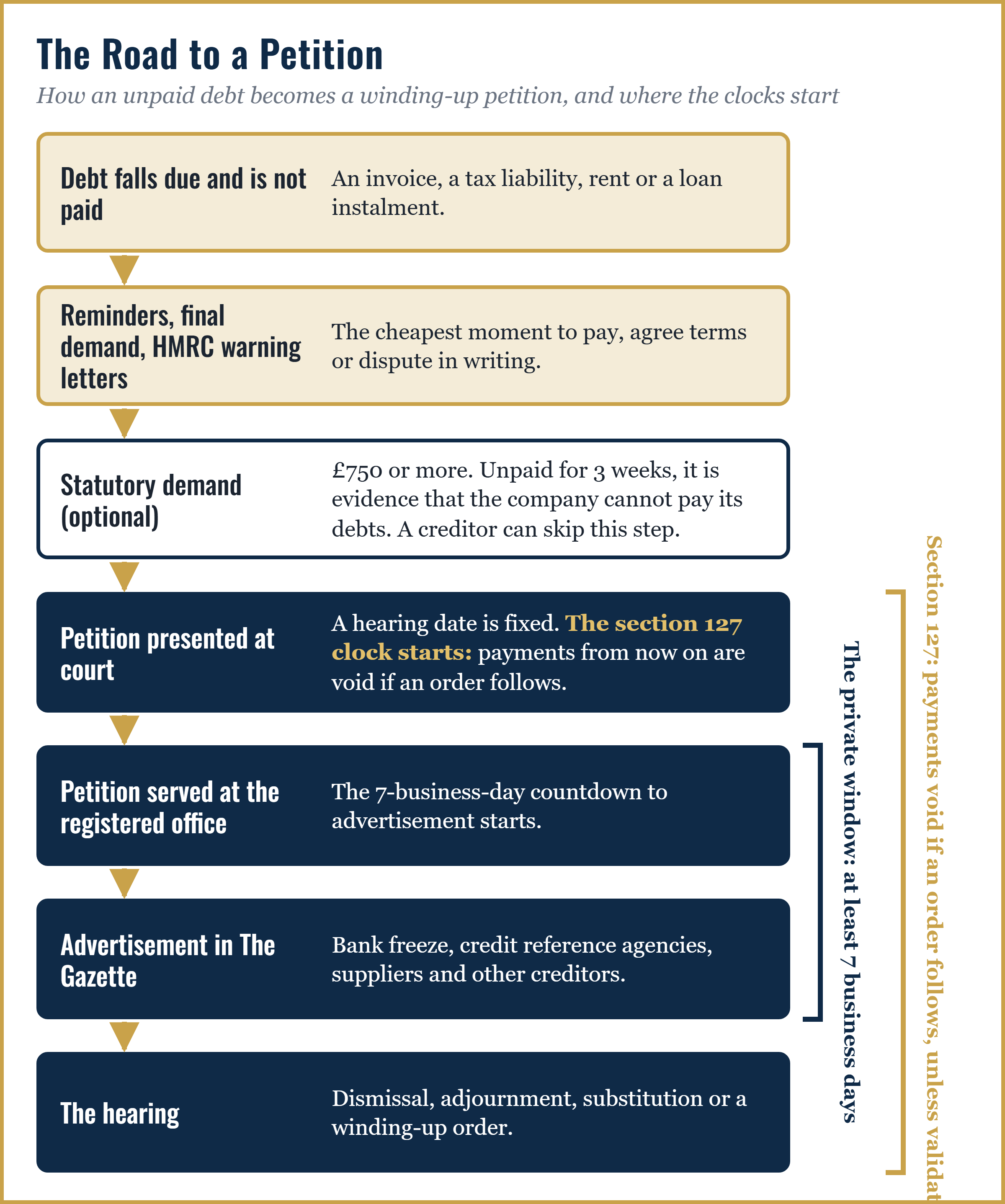
Petitions are sometimes dismissed because the petitioner got the procedure wrong: the petition was not properly served, it was advertised too early or too late, the certificate of compliance was not filed at least 5 business days before the hearing, or nobody attended for the petitioner. In those cases the court has not decided anything about the debt. The creditor can usually present a fresh petition, which starts the timetable again: service, advertisement no earlier than 7 business days after service, and a new hearing date. See winding-up petition not served properly and what happens if the petitioner does not turn up.
A procedural dismissal is breathing space, not an answer. Use the time to pay, agree terms, or put the company into a procedure that protects it.
Broken payment deals
Many petitions end because the company and the petitioner agree instalments and the petition is withdrawn or dismissed by consent. If the company then misses a payment, the creditor can present a new petition for the unpaid balance, and the agreement often records that it may. HMRC in particular is unlikely to agree terms a second time with a company that has broken a plan made to end a petition. See can we agree instalments on a winding-up petition? and will HMRC accept instalments after a winding-up petition?
DO NOT agree instalments the company cannot keep. A second petition after a broken deal is usually harder to stop than the first.
Other creditors are never barred
A petition is a remedy for all the company's creditors, not only the one who presented it. If the petitioner is paid but other creditors are owed money, any of them can give notice and ask to be substituted as petitioner before the petition is dismissed, or present a petition of their own afterwards. A dismissal on one creditor's petition does not protect the company against anyone else. See another creditor taking over the petition.
What a second petition means in practice
- The bank. If the first petition was advertised, the company's bank is likely to have seen it. A second advertised petition will usually lead to the account being frozen again; see winding-up petition: bank account frozen.
- The court. A company with a history of petitions, broken promises or repeated adjournment requests will usually find the court less willing to give more time.
- Your own position. Repeated petitions are evidence that the company could not pay its debts as they fell due. If the company later goes into liquidation, a liquidator may use the first petition as the date from which a director should have acted; see wrongful trading.
- Payments. Section 127 applies to each petition from its own presentation: payments out of the company's property after the new petition is presented are void if a winding-up order follows, unless the court validates them.
In the Director Aid Petition Figures, 294 notices of the dismissal of a petition were advertised in England and Wales in the twelve months to October 2026, against 5,960 petitions advertised (how many petitions are dismissed). Where a petition ends without a winding-up order, it is commonly because the debt has been paid or settled, which is why the terms of the deal that ends the first petition matter so much.
How to stop a repeat petition
- Find out exactly how the first petition ended. Get the order (dismissal or permission to withdraw) and any settlement terms in writing.
- If the debt is disputed, write to the creditor setting out the dispute and asking for confirmation that it will not present a further petition; if it threatens one, take advice on an injunction at once.
- If the debt is undisputed, deal with the cause: pay, or agree terms the cash-flow forecast shows the company can keep, recorded in writing.
- Check the other arrears. HMRC and other creditors who supported the first petition are the most likely next petitioners.
- If the company cannot pay its debts, take advice on the wider options now, while administration, a CVA or a moratorium are still open. See how to stop a winding-up petition.
- Use the free check to see whether a new petition has already been advertised: check for a winding-up petition against a company.
 From The Winding-Up Petition Handbook, free for directors.
Key points
- There is no fixed waiting period before a creditor can petition again; the reason the first petition ended decides the answer.
- A paid debt cannot found a new petition, but new unpaid debts can.
- A debt dismissed as genuinely disputed should go to the ordinary courts; a repeat petition on it can be restrained as an abuse.
- Procedural dismissals and broken payment deals are usually followed by a fresh petition.
- Other creditors are never barred by the dismissal of one creditor's petition.
Frequently asked questions
Can HMRC issue another winding-up petition after the first was dismissed? Yes, if the company still owes HMRC money it has not paid or agreed terms for, including new arrears that built up after the first petition ended.
Is there a time limit before a creditor can petition again? No. A fresh petition can be presented as soon as the creditor has a proper basis for one, which after a procedural dismissal can be within days.
If my company won on a disputed debt, is the claim over? Not necessarily. The winding-up court decides only that the dispute is genuine; the creditor can still sue for the money in the ordinary courts.
Does a dismissed petition stay on the record? If it was advertised, the Gazette notice of the petition remains and so does any notice of its dismissal. A petition withdrawn before advertisement leaves no public notice.
Free initial consultation for directors facing a winding-up petition. Call 07361 999123, text DIRAID to 82228, or request a call back.