
Before you instruct anyone, check they are a licensed insolvency practitioner, ask what the whole liquidation will cost and who pays, how the fee is fixed, what they will investigate about you, how they will treat your loan account and guarantees, and whether anyone is paid for introducing you. Remember the liquidator acts for the creditors, not for you, and the creditors can replace your choice. Directors also ask "how do I choose an insolvency practitioner?", "who chooses the liquidator in a creditors' voluntary liquidation?" and "can I pick my own liquidator?". This page sets out the questions and what good answers look like.
Thinking of liquidating the company? Free initial consultation with a Solicitor: call 07361 999123 or text DIRAID to 82228.
Your free call is with a Solicitor. Have the petition to hand if you can.
Text DIRAID to 82228and we will call you back
Or call us on 07361 999123
First consultation free · No obligation · Nothing to lose
Who actually chooses the liquidator
In a creditors' voluntary liquidation (CVL) the directors approach an insolvency practitioner, the shareholders pass a special resolution to wind up and nominate a liquidator, and the creditors are then asked to decide on the nomination, usually by deemed consent or a virtual meeting. If the creditors nominate someone different, their choice prevails (section 100 Insolvency Act 1986). So you choose who advises the company first and runs the process, but the creditors have the last word, and they can replace the liquidator later.
In a compulsory liquidation after a winding-up order, the directors do not choose at all: the Official Receiver becomes liquidator, and any private liquidator is chosen by the creditors or appointed by the Secretary of State. In the Director Aid Petition Figures, where a private liquidator replaces the Official Receiver the median gap is 77 days (how long until a liquidator is appointed). That loss of control is one reason directors of companies that cannot be saved often choose a CVL before a petition is heard.
CVLs are common: about 1,488 a month in England and Wales in the twelve months to October 2026, 17,862 in all (creditors' voluntary liquidations each month), against far fewer compulsory liquidations. Each liquidator's appointment record is in the insolvency practitioner directory.
The questions to ask
| Ask | Why it matters, and a good answer |
|---|---|
| Are you a licensed insolvency practitioner, and who licenses you? | Only a licensed practitioner can act as liquidator. Check the name on the Insolvency Service's register of practitioners. An adviser who is not licensed is selling an introduction. |
| Is a liquidation right, or is there a rescue option? | A good practitioner explains administration, a CVA, a moratorium or an informal deal with creditors, and why they do or do not fit. See administration to stop a winding-up petition. |
| What is your fee for getting the company into liquidation, and who pays it? | There is usually a fee for helping the directors prepare the statement of affairs and seek the creditors' decision. Ask whether it is paid by the company before appointment, by you personally, or out of the assets with the creditors' approval, and get it in writing. |
| How will your fee as liquidator be fixed? | The creditors approve the basis: a fixed fee, a percentage of what is realised, time spent, or a mix. If it is time spent, you and the creditors should see a fees estimate first. Ask what happens if there are no assets. |
| What will you investigate about me? | Every liquidator must look at the directors' conduct and report on it to the Insolvency Service within three months. Ask what records they need and how long the interview will take. A practitioner who promises the investigation will be a formality is not being straight with you. |
| What happens to my director's loan account? | If you owe the company money, the liquidator will collect it for the creditors. Ask how they will calculate it and whether they will agree terms. See overdrawn director's loan account. |
| What about my personal guarantees? | Liquidation usually triggers guarantees of the bank, the lease and finance agreements. The liquidator cannot advise you personally on them; ask whether you need separate advice. |
| Is anyone being paid for introducing me to you? | Payments to introducers should be disclosed to creditors. An unexplained "free liquidation" usually means someone else is being paid, often from the assets or from a claim you may not be entitled to make. |
| Can I or a new company buy the business or assets? | A liquidator must sell at proper value and tell creditors about sales to connected parties. Ask for an independent valuation. See can I buy the business back from the liquidator? |
| How long will it take, and how will you keep me informed? | Most CVLs take months, longer where there are claims. You will need to stay contactable and co-operate throughout. |
Who the liquidator works for
The practitioner you instruct before appointment advises the company on the process. Once appointed, the liquidator owes duties to the creditors as a whole, must be independent, and must investigate and, where justified, pursue claims, including claims against directors for wrongful trading, misfeasance or an overdrawn loan account. You cannot instruct a liquidator to protect you, and a good one will tell you so at the first meeting.
That is why many directors take their own advice alongside the practitioner's: on their personal guarantees, their loan account, any claim against them, and a pending petition. See solicitor or insolvency practitioner: who should you call first?
DO NOT sign an engagement letter, or pay a fee from the company's account, until you know what the whole process will cost and who the fee is really coming from.
If a winding-up petition has already been presented
A CVL can still be started after a petition is presented, but it does not stop the petition. The court decides at the hearing whether to make a compulsory order anyway, and the petitioner or other creditors may ask for one so that the Official Receiver investigates. A CVL supported by most of the independent creditors is more likely to be allowed to continue. See can I liquidate after a winding-up petition?
Payments out of the company's property after the petition was presented, including a practitioner's fee, are void if a winding-up order follows unless the court validates them (section 127). DO NOT pay the practitioner from the company's account after a petition is presented without advice on section 127. Use the free check to see whether a petition has been advertised against the company before you choose a route: check for a winding-up petition.
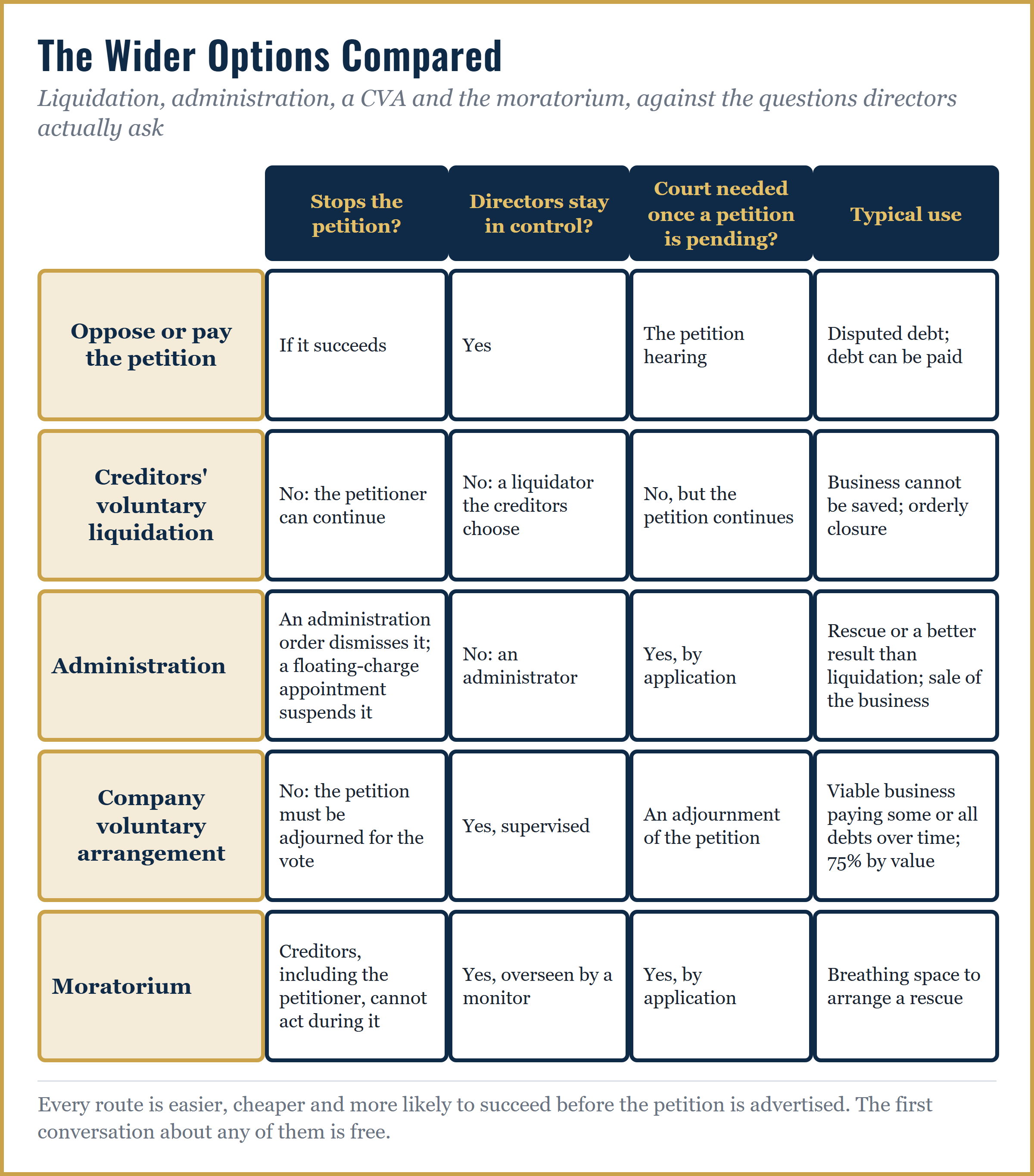 From The Winding-Up Petition Handbook, free for directors.
Key points
- Only a licensed insolvency practitioner can be liquidator; check the register before you instruct anyone.
- In a CVL the directors and shareholders nominate, but the creditors' choice prevails; in a compulsory liquidation the Official Receiver is liquidator.
- Get the pre-appointment fee, who pays it, and the basis of the liquidator's fee in writing.
- The liquidator acts for the creditors and must investigate your conduct; take your own advice on guarantees, your loan account and any claims.
- If a petition is pending, a CVL does not stop it and payments to the practitioner are caught by section 127.
Frequently asked questions
Can I choose my own liquidator? In a creditors' voluntary liquidation the directors and shareholders choose who to nominate, but the creditors can nominate someone else and their choice prevails. In a compulsory liquidation you do not choose.
How much does a liquidator cost? It depends on the company's size, assets and records; ask for the pre-appointment fee and the basis of the liquidator's fee in writing, and compare more than one practitioner.
Will the liquidator investigate me? Yes. Every liquidator must review the directors' conduct and report to the Insolvency Service within three months; most reports lead to no action.
Can the liquidator I appoint advise me personally? No. Once appointed they act for the creditors, so advice on your own guarantees, loan account or any claim against you should come from your own adviser.
Free initial consultation for directors of companies in financial difficulty. Call 07361 999123, text DIRAID to 82228, or request a call back.