
Read it carefully, keep to any date it gives, and take advice before you reply. A letter setting out the Insolvency Service's areas of concern means your conduct is being investigated with disqualification in mind; it is not yet a decision. Your written answer, with documents, is often the best chance you will have to close the case without action. Directors also ask "what happens during an Insolvency Service investigation?", "what is a director's conduct questionnaire and how should I respond?" and "how do I avoid disqualification after an investigation?". This page explains each stage, from the liquidator's questionnaire to the decision.
Letter from the Insolvency Service? Free initial consultation with a Solicitor: call 07361 999123 or text DIRAID to 82228.
Your free call is with a Solicitor. Have the petition to hand if you can.
Text DIRAID to 82228and we will call you back
Or call us on 07361 999123
First consultation free · No obligation · Nothing to lose
How an investigation starts
When a company goes into compulsory liquidation, creditors' voluntary liquidation or administration, the office-holder (the Official Receiver, the liquidator or the administrator) must send the Insolvency Service a report on the conduct of everyone who was a director in the three years before the insolvency. The report is due within three months of the insolvency date (section 7A Company Directors Disqualification Act 1986). It is confidential and is not shared with creditors.
The Insolvency Service reviews every report and decides whether there is enough to investigate and whether that is in the public interest. Most reports go no further. It can also investigate the directors of companies that were dissolved without a formal insolvency.
The first step for most directors is therefore not the Insolvency Service at all. It is the office-holder's questionnaire.
The director's questionnaire
Liquidators and administrators usually send each director a questionnaire about the company's history, its records, when the directors knew it was in difficulty, what they did about it, payments to themselves and connected people, and the movement of assets. After a winding-up order, the Official Receiver sends a questionnaire and usually interviews the director. See will I be investigated after the company is wound up?
Answer it fully, accurately and on time, and keep a copy of what you send. The answers feed into the conduct report. A director who does not co-operate gives the office-holder a ground for criticism in itself; after a compulsory liquidation, failure to co-operate with the Official Receiver can lead to a court order to attend and answer questions.
The investigation letter
If the Insolvency Service decides to investigate, it writes to the director setting out its initial areas of concern and inviting comments. It may write again with further questions and requests for documents, and it can interview directors and others. It has power to require information and records relevant to a director's conduct (section 7(4)).
Investigators also make enquiries of others: creditors, the office-holder, the company's accountant and bank, and HMRC. Your account is only one source, which is why it should be complete and supported by documents.
The concerns raised most often are:
- trading on while the company could not pay its debts, often at the expense of HMRC; see wrongful trading: what directors must do;
- payments to directors, connected companies or creditors with personal guarantees ahead of other creditors;
- moving assets, money or the business out of the company before or around the insolvency;
- missing or incomplete accounting records, and accounts and returns not filed;
- an overdrawn director's loan account or dividends paid without profits;
- misuse of a Bounce Back Loan or other government-backed lending.
How to reply
- Note the date for a reply. If you need more time to gather records, ask for it in writing before the date passes.
- Gather the documents first: bank statements, management accounts, board minutes, correspondence with creditors and HMRC, advice you received and when, and any payment plans proposed.
- Answer each concern separately, with dates and documents. Explain what you knew, when you knew it, and what you did.
- Explain, do not argue. Accept what is plainly right and give context. A reply that denies documented facts damages your credibility on the points you can win.
- Take advice before you send it. The reply is evidence. It may be relied on later in court.
If you do not reply, the Insolvency Service decides on the information it has from other sources.
DO NOT ignore an Insolvency Service letter, destroy or alter company records, or contact creditors or former staff to influence what they say. Each can be treated as further misconduct.
If you are invited to an interview under caution, that is a criminal investigation, which is separate from disqualification. Take advice from a solicitor before you attend.
The possible outcomes
| Outcome | What happens next |
|---|---|
| No further action | You are told the case is closed |
| Disqualification proposed | You receive a summary of the alleged misconduct and are invited to respond, and often to offer an undertaking |
| Referral elsewhere | Information can be passed to another enforcement body |
If the Insolvency Service decides to apply to court, it must give you at least 10 days' notice (section 16). You can offer a disqualification undertaking at any stage. An undertaking accepted before proceedings begin usually avoids paying the Insolvency Service's costs; one offered after proceedings start may not. A disqualification, by undertaking or order, lasts between 2 and 15 years. The full process, the bands and the choice between an undertaking and a court case are in can I be disqualified after liquidation?
The time limit
The Insolvency Service must usually apply to court within three years of the date the company became insolvent, or of its dissolution; the court can allow a later application. A letter arriving two years after the liquidation is therefore not too late, and the investigation can take many months.
How a winding-up petition leads here
Many investigations begin with a winding-up petition. In the Director Aid Petition Figures, 61% of petitions advertised since November 2023 were followed by a winding-up order within a year (what proportion end in an order). Every one of those orders makes the Official Receiver liquidator and starts the reporting process. What a director does while a petition is pending, such as paying connected creditors or moving money out, is exactly what an investigation examines. If your company has a petition now, see how to stop a winding-up petition.
What it means for you personally
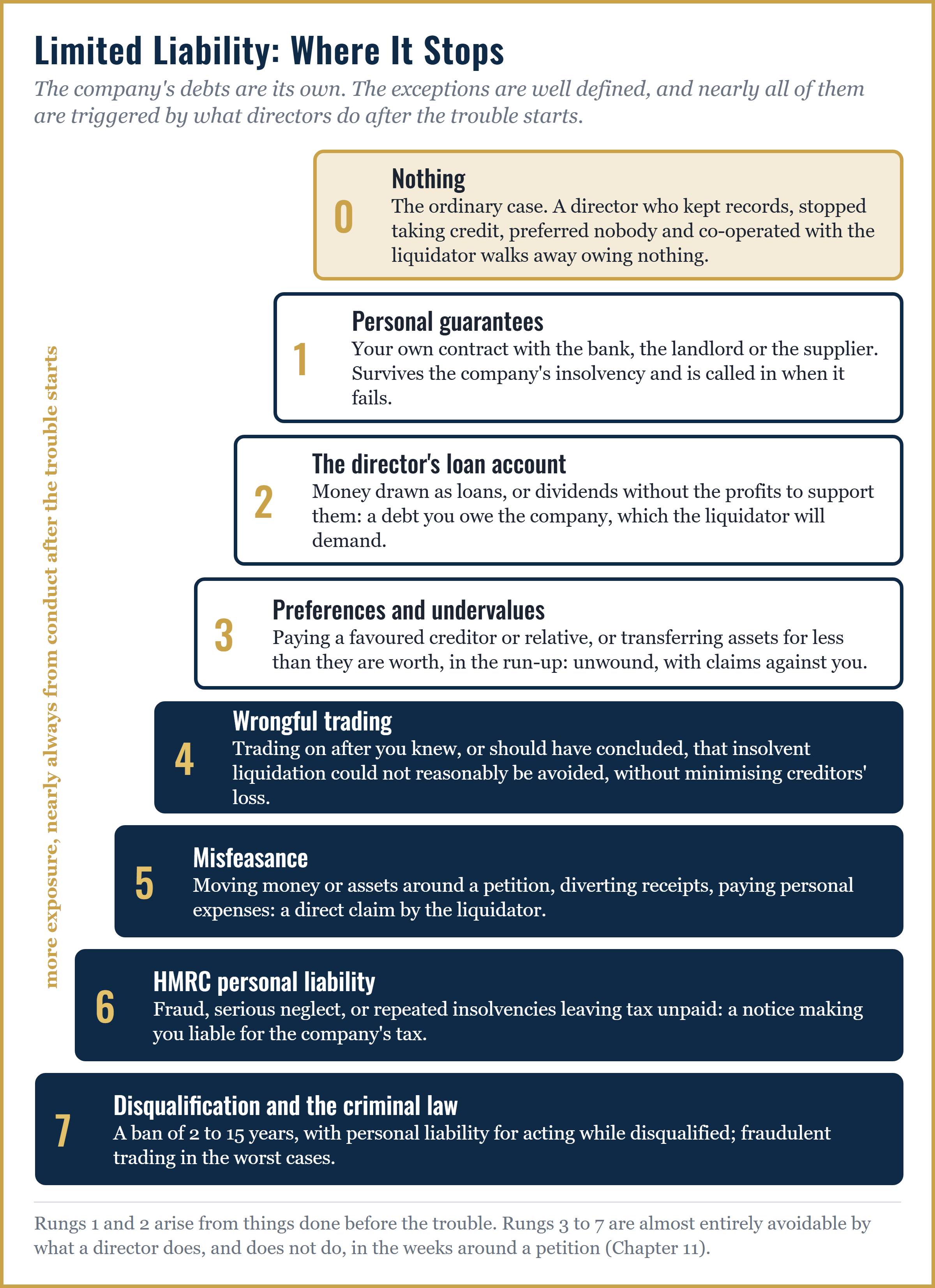
Disqualification is not the only exposure. The liquidator may bring separate claims against you for an overdrawn loan account, preferences, misfeasance or wrongful trading, and the Insolvency Service can seek a compensation order for creditors' losses after a disqualification. A single, consistent account of events, given early with advice, protects you across all of them. See defending a liquidator's claim against a director. Shadow and de facto directors can be investigated too; see can a shadow director be disqualified?
 From The Winding-Up Petition Handbook, free for directors.
Key points
- The office-holder reports on every director within three months; most reports lead to no action.
- An investigation letter sets out concerns and invites your comments: it is not a decision.
- Answer each concern with dates and documents, on time, after advice.
- The Insolvency Service must give at least 10 days' notice before applying to court, and usually must apply within three years.
- An undertaking offered before proceedings usually avoids the Insolvency Service's costs.
Frequently asked questions
What happens during an Insolvency Service investigation? The investigator reviews the office-holder's report and the company's records, writes to you with its concerns and questions, may interview you and others, and then decides whether to take no action, propose disqualification or refer the matter elsewhere.
What is a director's conduct questionnaire and how should I respond? It is the office-holder's set of questions about the company's history, records, payments and when you knew of its difficulties; answer fully, accurately and on time, with documents, and keep a copy.
How do I avoid disqualification after an investigation? By showing, with documents, that you kept records, took advice when the warning signs appeared, did not prefer yourself or connected creditors, and co-operated; there is no guarantee, and advice before replying matters.
How long does an Insolvency Service investigation take? It varies; many take several months. Proceedings must usually start within three years of the insolvency.
Free initial consultation for directors of companies in financial difficulty. Call 07361 999123, text DIRAID to 82228, or request a call back.