
Instruct a licensed insolvency practitioner; the board resolves the company cannot continue because of its debts; the shareholders pass a special resolution (75%) to wind it up. The directors send creditors a statement of affairs within 7 days, the creditors confirm or replace the liquidator within 14 days, and the liquidator takes over. Directors also ask "how do I liquidate my company?", "how do I close a limited company with debts?" and "what is a creditors' voluntary liquidation?". This page sets out each step, what it costs, and what to settle before you start.
Company can't carry on? Free initial consultation with a Solicitor: call 07361 999123 or text DIRAID to 82228.
Your free call is with a Solicitor. Have the petition to hand if you can.
Text DIRAID to 82228and we will call you back
Or call us on 07361 999123
First consultation free · No obligation · Nothing to lose
When a CVL is the right route
A creditors' voluntary liquidation is the formal way to close a company that cannot pay its debts. It is by far the most common insolvency procedure in England and Wales: there were 19,057 in 2025, against 3,454 compulsory winding-up orders, and 1,486 in October 2026 alone (the Director Aid Petition Figures; how many companies go into creditors' voluntary liquidation each month?). Companies that close this way are typically about 8 years old (how old are companies that become insolvent?).
It suits a company that is insolvent and has no realistic prospect of recovery. If the business could survive without its old debts, look first at a CVA or administration. A solvent company is closed by a members' voluntary liquidation instead, which is a different process. Striking a company off with debts outstanding is not a substitute: creditors can object and the company can be restored.
The steps
- Instruct an insolvency practitioner. Only a licensed insolvency practitioner can act as liquidator. The directors choose who to approach, though the creditors have the final say. See choosing a liquidator: the questions to ask.
- Board meeting. The directors resolve that the company cannot continue trading because of its liabilities, and call a general meeting of the shareholders, or circulate a written resolution.
- Shareholders' special resolution. The shareholders resolve to wind the company up voluntarily (section 84 Insolvency Act 1986). A special resolution needs at least 75% of the votes. A private company's general meeting needs 14 clear days' notice unless holders of at least 90% of the shares agree to short notice (or a higher percentage, up to 95%, if the articles require it). The shareholders also nominate a liquidator.
- Statement of affairs. The directors make out a statement of the company's assets, debts and creditors, verified by a statement of truth, and send it to the creditors within 7 days of the resolution (section 99). The insolvency practitioner usually prepares it with you.
- The creditors' decision. No later than 14 days after the resolution, the creditors are asked to nominate a liquidator, by deemed consent or a virtual meeting (section 100). If they nominate someone different, the creditors' choice prevails.
- Appointment and notices. The liquidator is appointed, the resolution goes to Companies House, and a notice appears in the Gazette. From then on, all creditor claims go to the liquidator.
What happens next
On the liquidator's appointment the directors' powers end (section 103). The liquidator takes control of the assets and records, closes the business, sells what can be sold, agrees creditors' claims and pays what is available in the statutory order: fixed-charge holders from their security, then the costs, then preferential creditors (including employees and, for some taxes, HMRC), then a lender with a floating charge (after a share set aside for unsecured creditors), then unsecured creditors. Within three months the liquidator must report to the Insolvency Service on the conduct of everyone who was a director in the last three years. At the end the liquidator files a final account and the company is dissolved. See what happens to directors in liquidation.
Employees are dismissed when the business stops. They can claim statutory redundancy pay, notice pay and some arrears of wages and holiday pay, up to the statutory limits, from the Redundancy Payments Service. A director with a contract of employment may also be able to claim; eligibility is checked case by case. See what happens to employees.
What it costs
There are two costs. The first is the fee for getting the company into liquidation: calling the meetings and preparing the statement of affairs. It is commonly paid from the company's money before the resolution, or by the directors or shareholders where the company has none. The second is the liquidator's fees for the liquidation itself, paid from the assets, on a basis the creditors approve. Ask for both in writing before you instruct anyone, and ask what happens to the second if the assets are small.
Before you start: the things that come back to directors
- Stop taking credit and deposits you know the company cannot honour. Trading on once you know insolvent liquidation cannot be avoided is wrongful trading.
- Do not pay yourself, family or connected creditors ahead of others, and do not sell assets cheaply. Both are open to challenge as preferences or transactions at an undervalue.
- Your loan account. An overdrawn director's loan account is a debt the liquidator will collect. See overdrawn director's loan account.
- Personal guarantees are usually called on when the company goes into liquidation. See defending a personal guarantee claim.
- Keep the records together: bank statements, accounts, VAT and payroll records. The liquidator will ask for them.
CVL or a winding-up petition?
Leaving it too long often decides the route for you. If a creditor, usually HMRC, presents a winding-up petition first, the company can still pass a resolution for a CVL, but the petition does not go away: the court can still make a winding-up order, in which case the Official Receiver becomes liquidator and investigates, and payments made since the petition was presented are void unless validated. See can I liquidate after a winding-up petition? and served with a winding-up petition. If a statutory demand has arrived, the time to decide is now: see statutory demand received.
DO NOT wait for a petition before acting. A director who arranges an orderly CVL keeps the choice of liquidator and avoids the Official Receiver's investigation that follows a compulsory order.
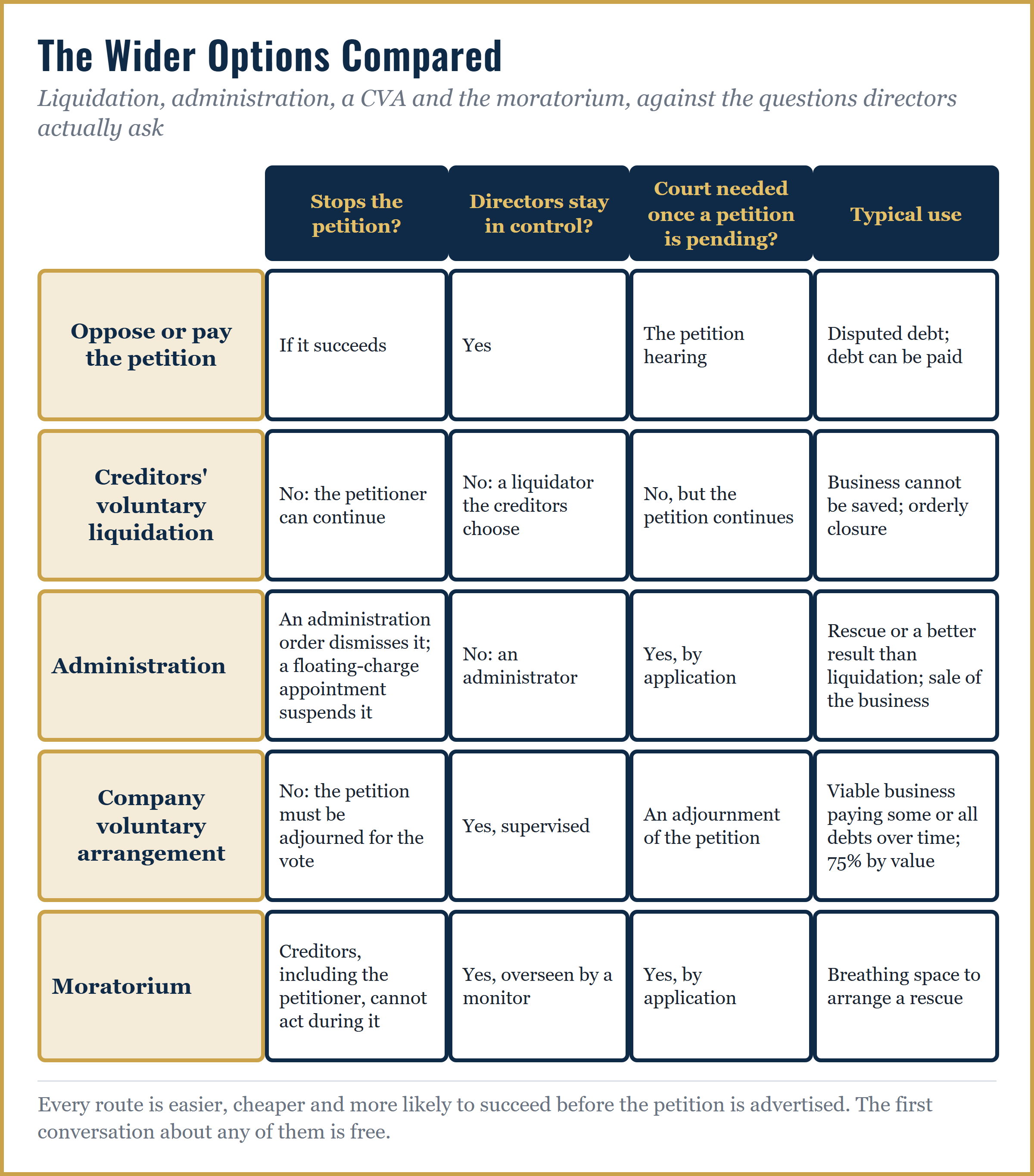 From The Winding-Up Petition Handbook, free for directors.
Key points
- A CVL needs a licensed insolvency practitioner, a board resolution and a shareholders' special resolution (75%).
- The directors send creditors a statement of affairs within 7 days; the creditors confirm or replace the liquidator within 14 days.
- The directors' powers end when the liquidator is appointed, and the liquidator reports on their conduct within three months.
- Employees claim redundancy and other pay from the Redundancy Payments Service.
- Acting before a creditor petitions keeps the choice of liquidator with the directors and avoids a compulsory order.
Frequently asked questions
How long does it take to put a company into liquidation? Usually days or weeks rather than months: it depends on whether the shareholders agree to short notice and on the timetable for the creditors' decision.
Can I choose the liquidator? The directors and shareholders nominate one, but the creditors have the final say and can replace your choice.
Who pays for a creditors' voluntary liquidation? The fee for starting it is usually paid from the company's money or by the directors; the liquidator's fees for the liquidation come from the assets, as the creditors approve.
Can I liquidate my company if it has a winding-up petition? Yes, the shareholders can still resolve to wind up, but the petition continues and the court can still make a compulsory order.
Free initial consultation for directors of companies in financial difficulty. Call 07361 999123, text DIRAID to 82228, or request a call back.