
Yes. Any creditor can give the petitioner notice that it will appear at the hearing to support or oppose the petition, by 4pm on the business day before the hearing. A supporting creditor can take over the petition if the petitioner is paid, so paying the petitioner alone may not end it. Opposing creditors can persuade the court to adjourn or dismiss, but their views are weighed by the value of their debts and the reasons they give. Directors also ask "what is a supporting creditor?", "can HMRC join someone else's winding-up petition?" and "can creditors stop a winding-up order?". This page explains both sides and what to do before the hearing.
Hearing coming up? Free initial consultation with a Solicitor: call 07361 999123 or text DIRAID to 82228.
Your free call is with a Solicitor. Have the petition to hand if you can.
Text DIRAID to 82228and we will call you back
Or call us on 07361 999123
First consultation free · No obligation · Nothing to lose
Why other creditors get involved
A winding-up order is made for the benefit of all the company's creditors, not only the one who presented the petition. Once a petition is advertised in the Gazette, every creditor is on notice and can take part. Creditors who are owed money and see the advertisement often decide that a liquidation is their best chance of recovering something, or of having the directors' conduct investigated. Others, usually suppliers who want the company to keep trading, may prefer to oppose.
How a creditor gives notice
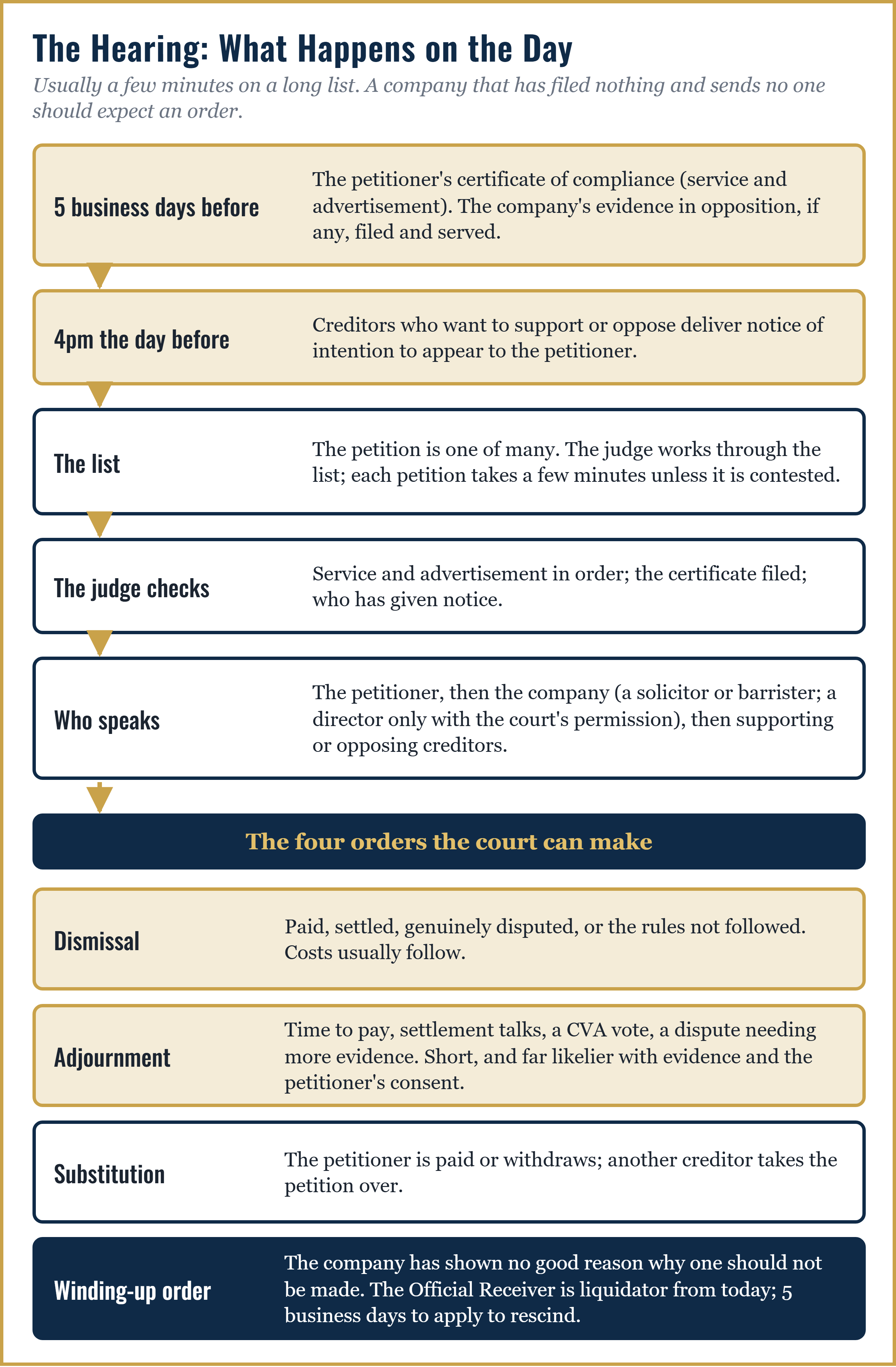
A creditor who intends to appear at the hearing must deliver a notice of intention to appear to the petitioner or its solicitor, so that it arrives no later than 4pm on the business day before the hearing (Insolvency (England and Wales) Rules 2016). The notice gives the creditor's name and address, the amount and nature of its debt, and whether it intends to support or oppose the petition. A creditor who has not given notice can appear only with the court's permission.
Before the hearing starts, the petitioner hands the court a list of everyone who has given notice, showing the amount each claims and whether each supports or opposes. That list is the best guide to what will happen on the day.
Ask the petitioner's solicitors for the list of persons intending to appear, the day before the hearing and again on the morning. It tells you who else must be dealt with.
Supporting creditors: why paying the petitioner may not be enough
If the petitioner is paid and asks to withdraw, or does not attend, or does not ask for an order, the court can substitute a supporting creditor as petitioner, on such terms as it thinks just. The petition then continues on that creditor's debt, often with a short adjournment so that the change can be made. See another creditor taking over the winding-up petition and the glossary entry for a supporting creditor.
The practical consequences for a director:
- Pay or settle every creditor who has given notice to support, not only the petitioner, if the aim is to have the petition dismissed.
- Expect HMRC. HMRC regularly gives notice to support petitions presented by other creditors where the company owes it tax. A company that settles with a trade creditor and ignores its VAT or PAYE arrears often finds HMRC substituted.
- Watch the timing. Notices can arrive until 4pm the day before the hearing, so a settlement agreed a week earlier can be overtaken by a creditor who appears late.
- Get any settlement in writing with the petitioner and each supporting creditor, recording that they will not oppose dismissal and how costs are dealt with.
DO NOT pay the petitioner from the company's bank account without advice. Payments out of the company's property after presentation are void if an order follows unless the court validates them (section 127), and a supporting creditor makes an order more likely. See paying the debt to stop the petition and can a director lend the company money to pay?
Opposing creditors: what they can and cannot achieve
The court has a discretion whether to make a winding-up order, and it may have regard to the wishes of the creditors, weighed by the value of each creditor's debt (section 195 Insolvency Act 1986). In practice:
- An unpaid creditor whose debt is not disputed, against a company that cannot pay, will usually get its order even if some creditors oppose.
- Opposition counts for more where it comes from independent creditors with a large share of the debts and gives a good reason, such as a voluntary liquidation already under way, a realistic rescue proposal, or a sale that will pay creditors more.
- Opposition from creditors connected with the company (directors, shareholders, group companies, family members) is usually given much less weight.
- Opposition that only says "please give the company more time", without evidence it can pay, rarely succeeds.
An opposing creditor gives notice in the same way. Many directors ask key suppliers or a major customer to write supporting an adjournment; a letter can help, but a creditor who actually gives notice of intention to appear, with the amount of its debt, carries more weight.
How this fits with the company's own case
The company's evidence opposing the petition must be filed and served at least 5 business days before the hearing. Creditors' support for the company is not a substitute for that evidence. If the company's case is that the debt is disputed, or that it will pay, or that a rescue procedure is being arranged, it needs its own witness statement in time, with the creditors' position as part of the picture. See how to defend a winding-up petition and how to prepare for the hearing.
Costs
Creditors who appear to support a successful petition may ask for their costs. The court has a discretion, and supporting creditors are often allowed less than the petitioner or nothing; where costs are allowed they are paid as an expense out of the company's assets in the liquidation, if there are enough. A supporting creditor who is substituted as petitioner will usually ask for its costs to be dealt with as the petitioner's would have been. If the petition is dismissed after the company pays, the settlement normally has to cover the petitioner's costs and often the supporting creditors' as well.
What the figures show
In the Director Aid Petition Figures, 61% of the petitions advertised since November 2023 were followed by a winding-up order within a year, and about 4% by an advertised dismissal (what proportion of petitions end in an order). The companies that avoid an order are usually the ones that dealt with the petitioner and every supporting creditor before the hearing, not on the day.
 From The Winding-Up Petition Handbook, free for directors.
Key points
- Any creditor can support or oppose the petition by giving the petitioner notice by 4pm on the business day before the hearing.
- The petitioner hands the court a list of everyone who has given notice; ask for it.
- A supporting creditor can be substituted as petitioner, so settle with every supporting creditor, not only the petitioner.
- The court may have regard to creditors' wishes, weighed by the value of their debts; connected creditors count for less.
- Creditors' support is no substitute for the company's own evidence, filed at least 5 business days before the hearing.
Frequently asked questions
What is a supporting creditor? A creditor, other than the petitioner, that has given notice that it will appear at the hearing to support the petition. It can ask to take over the petition if the petitioner drops out.
Can HMRC join a petition presented by a supplier? Yes. HMRC can give notice to support any creditor's petition where the company owes it money, and can ask to be substituted if the petitioner is paid.
Can creditors stop a winding-up order? Sometimes. Independent creditors with a substantial share of the debts and a good reason can persuade the court to adjourn or dismiss, but an undisputed unpaid debt against a company that cannot pay usually leads to an order.
Can a creditor appear without giving notice? Only with the court's permission, which is given at the court's discretion on the day.
Free initial consultation for directors facing a winding-up petition. Call 07361 999123, text DIRAID to 82228, or request a call back.