
Within a year of being advertised, 62% of winding-up petitions against companies in England and Wales end in a winding-up order, usually within about 25 days. 7% end in an advertised dismissal, 13% in a creditors' voluntary liquidation and 2% in administration instead, and 15% are followed by no further notice at all, which usually means the debt was paid or settled. These figures follow 35,131 petitions advertised from October 2016 to 16 November 2025, each for a full year. They were updated on 16 November 2026.
Facing a winding-up petition? Free initial consultation with a Solicitor: call 07361 999123 or text DIRAID to 82228. These are averages; what happens to your company depends on what you do before the hearing.
Your free call is with a Solicitor. Have the petition to hand if you can.
Text DIRAID to 82228and we will call you back
Or call us on 07361 999123
First consultation free · No obligation · Nothing to lose
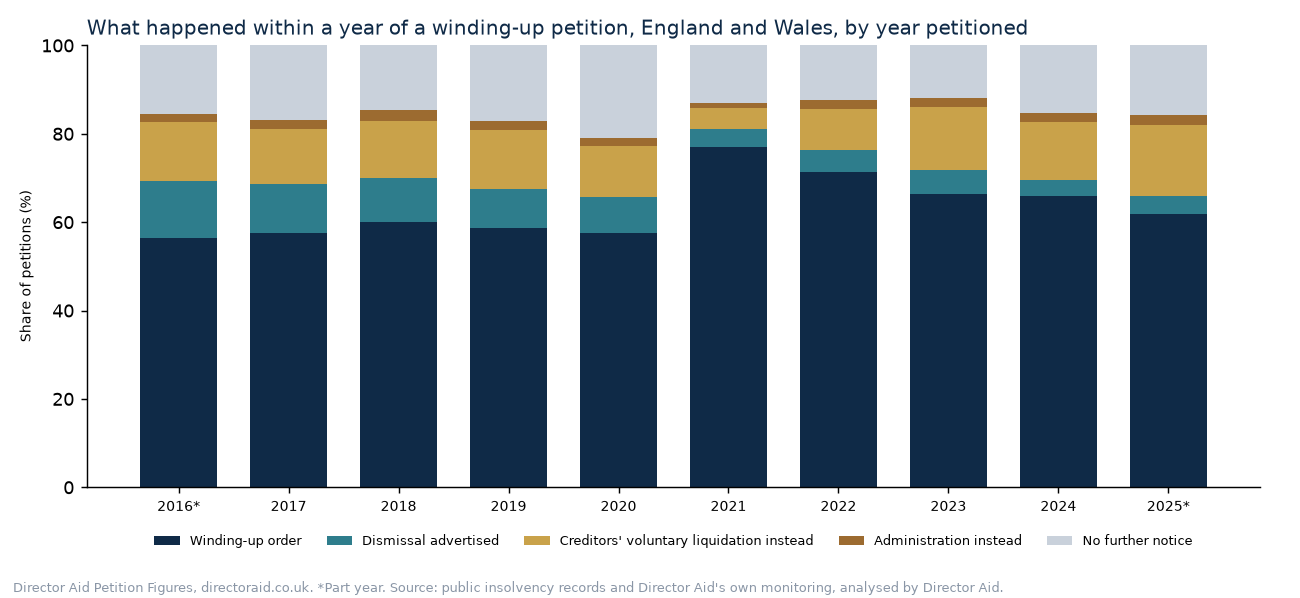
What happened to the petitions, year by year
| Year petitioned | Petitions | Order | Dismissal advertised | CVL instead | Administration instead | No further notice | Median days to order |
|---|---|---|---|---|---|---|---|
| 2016 (from October) | 1,258 | 56% | 13% | 13% | 2% | 15% | 26 |
| 2017 | 4,234 | 58% | 11% | 12% | 2% | 17% | 23 |
| 2018 | 4,898 | 60% | 10% | 13% | 2% | 15% | 24 |
| 2019 | 4,714 | 59% | 9% | 13% | 2% | 17% | 27 |
| 2020 (Covid restrictions) | 1,791 | 57% | 8% | 12% | 2% | 21% | 32 |
| 2021 (Covid restrictions) | 654 | 77% | 4% | 5% | 1% | 13% | 36 |
| 2022 | 2,938 | 71% | 5% | 9% | 2% | 12% | 27 |
| 2023 | 4,210 | 66% | 5% | 14% | 2% | 12% | 24 |
| 2024 | 4,929 | 66% | 4% | 13% | 2% | 15% | 22 |
| 2025 (to 16 November 2025) | 5,505 | 62% | 4% | 16% | 2% | 16% | 22 |
Each petition is counted once, by the first of these to follow it for the same company within a year: a winding-up order (or a liquidator appointed by the court), an advertised dismissal, a creditors' voluntary liquidation, or administration. "No further notice" means none of these followed: in most cases the debt was paid or settled and the petition was withdrawn or dismissed without being advertised. Petitions from 2016 cover October to December only. 2020 and 2021 were the years of the Covid restrictions on winding-up petitions (to 30 September 2021), followed by transitional measures to 31 March 2022: few petitions were brought, and in 2021 those that were ended in an order 77% of the time. Figures for 2025 may slightly understate orders: fewer orders appeared in the public notices in late 2025 than the official statistics record for those months.
Does it matter who brings the petition?
The latest three years of petitions that have had a full year to run, by petitioner:
| Petitioner | Petitions | Order | Dismissal advertised | CVL instead | Administration instead | No further notice |
|---|---|---|---|---|---|---|
| HMRC | 8,255 | 61% | 4% | 21% | 2% | 12% |
| Trade creditors | 3,832 | 67% | 5% | 8% | 2% | 17% |
| Lenders and banks | 858 | 72% | 4% | 7% | 2% | 15% |
| Landlords | 254 | 65% | 5% | 7% | 4% | 19% |
| Local authorities | 365 | 60% | 12% | 4% | 1% | 24% |
| Other petitioners | 1,569 | 75% | 3% | 4% | 2% | 16% |
HMRC petitions end in a winding-up order 61% of the time, less often than petitions by other creditors (69%). Where HMRC is the petitioner, the company is more likely to go into a creditors' voluntary liquidation instead (21%, against 7%), which suggests that directors facing HMRC more often choose to close the company themselves before the hearing.
How long it takes
Where a winding-up order follows, the median time from the advertisement of the petition to the order is 25 days. A quarter of orders come within 20 days and a quarter take longer than 47 days, usually because the hearing was adjourned for a payment plan, a dispute or a change of petitioner. The advertisement comes at least seven business days after the petition is served, so the time from service to order is longer still.
What this means if your company has a petition
The order rate is high because most companies do nothing effective between service and the hearing: the debt is not paid, nothing is filed to dispute it, and nobody attends. The petitions that end without an order are overwhelmingly the ones where the company acted early: it paid or agreed terms, disputed the debt on proper grounds, or chose another procedure, such as administration, while it still could. Read what to do if you have been served, how to stop a winding-up petition and how to get a winding-up petition dismissed.
Key points
- 62% of winding-up petitions end in a winding-up order within a year; 15% are followed by no further notice, usually because the debt was paid or settled.
- The median time from advertisement to order is 25 days.
- About one petition in 7 ends in a creditors' voluntary liquidation or administration instead.
- In 2024, 66% of petitions ended in an order, against 59% in 2019.
- The yearly figures are free to download below.
Frequently asked questions
What usually happens after a winding-up petition? In 62% of cases a winding-up order is made within a year, usually at the first or second hearing. Most of the rest are paid, settled or dismissed, and a minority end in another insolvency procedure.
How long after a winding-up petition is the company wound up? The median is 25 days from the advertisement of the petition to the winding-up order. The first hearing is usually six to eight weeks after the petition is presented.
Can a company survive a winding-up petition? Yes. Around 15% of petitions are followed by no further notice, and 7% by an advertised dismissal. Most of those are companies that paid, settled or disputed the debt before the hearing.
Are HMRC petitions more likely to end in a winding-up order? No, slightly less likely. Over the latest three full years, 61% of HMRC petitions ended in an order, against 69% of petitions by other creditors; companies facing HMRC more often go into creditors' voluntary liquidation instead (21%).
Download
- Outcomes by year petitioned since October 2016, CSV
- Winding-up petitions and orders since October 2016
- What proportion of petitions end in an order: the latest three years
How the figures are compiled: the method.
Facing a winding-up petition? Free initial consultation with a Solicitor: call 07361 999123 or text DIRAID to 82228. The figures above are what usually happens; what happens to your company depends on what you do in the next few days.
Quote these figures freely with credit to the Director Aid Petition Figures and a link to this page. Licence: Creative Commons Attribution 4.0. Source: public insolvency records and Director Aid's own monitoring, analysed by Director Aid. Contains public sector information licensed under the Open Government Licence v3.0.