
A residents' management company (RMC) or right to manage (RTM) company is an ordinary company, so a contractor, managing agent or other creditor owed more than £750 can petition to wind it up. The leases and the flats are not lost, but the company's control of the block, and any freehold it owns, would pass to a liquidator. Directors also ask "what happens if our management company goes bust?", "is the service charge money safe?" and "are volunteer directors liable?". This page explains the answers and the steps that usually resolve the problem.
Flat management company facing a petition? Free initial consultation with a Solicitor: call 07361 999123 or text DIRAID to 82228.
Your free call is with a Solicitor. Have the petition to hand if you can.
Text DIRAID to 82228and we will call you back
Or call us on 07361 999123
First consultation free · No obligation · Nothing to lose
Why flat management companies get petitions
Most RMCs and RTM companies have no money of their own. They pay for repairs, insurance, cleaning and management out of the service charges the leaseholders pay. Petitions usually follow one of a few patterns:
- Major works. A contractor finished a roof, cladding or decoration job and the company cannot pay the final account because leaseholders have not paid their share, or the works cost more than was collected.
- Unpaid fees. A former managing agent claims unpaid fees or termination costs after being replaced.
- Insurance and utilities. The buildings insurance premium or communal electricity is unpaid.
- Leaseholder disputes. A group of leaseholders withholds service charges in protest, leaving the company unable to pay its suppliers.
A creditor still needs a debt of more than £750 that the company cannot pay. Property-related businesses accounted for 1,089 petitions in England and Wales since November 2023, 6% of the total (Director Aid Petition Figures).
The company's best answer is usually its own leaseholders
Unlike a trading company, a management company can usually raise money by demanding service charges under the leases. Before or soon after a petition, the directors should:
- Check the lease. Who pays what, and whether the lease allows interim demands, a reserve fund or a one-off demand for a shortfall.
- Issue valid demands. A service charge demand must be properly made under the lease and accompanied by the statutory summary of leaseholders' rights and obligations, or the leaseholder can withhold payment. Costs incurred more than 18 months before they are demanded may not be recoverable unless leaseholders were told about them in writing within that period.
- Check the major works consultation. If the works were qualifying works and the statutory consultation was not carried out, the company's recovery from each leaseholder may be capped at £250 unless the First-tier Tribunal (Property Chamber) grants dispensation. That affects how the company pays the contractor.
- Chase arrears. The company can claim unpaid service charges from leaseholders, and a disputed service charge can be decided by the tribunal.
- Talk to the creditor. A contractor who knows the money is being collected from leaseholders will often agree a timetable. See can we agree instalments on a winding-up petition?
If the contractor's bill itself is genuinely disputed (defective work, unagreed extras), the petition is the wrong procedure for it. See disputed debt and a winding-up petition.
Is the service charge money safe?
Where the leases make service charges payable to the management company, the money it receives is usually held on a statutory trust under section 42 of the Landlord and Tenant Act 1987: first to pay the costs it was collected for, and then for the contributing leaseholders. Money held on trust is generally not the company's own property available to its creditors at large, but it can properly be used to pay the costs it was collected for, which may include the petitioning contractor's bill. Whether a particular fund is covered depends on the leases and how the money has been held, so take advice before relying on it.
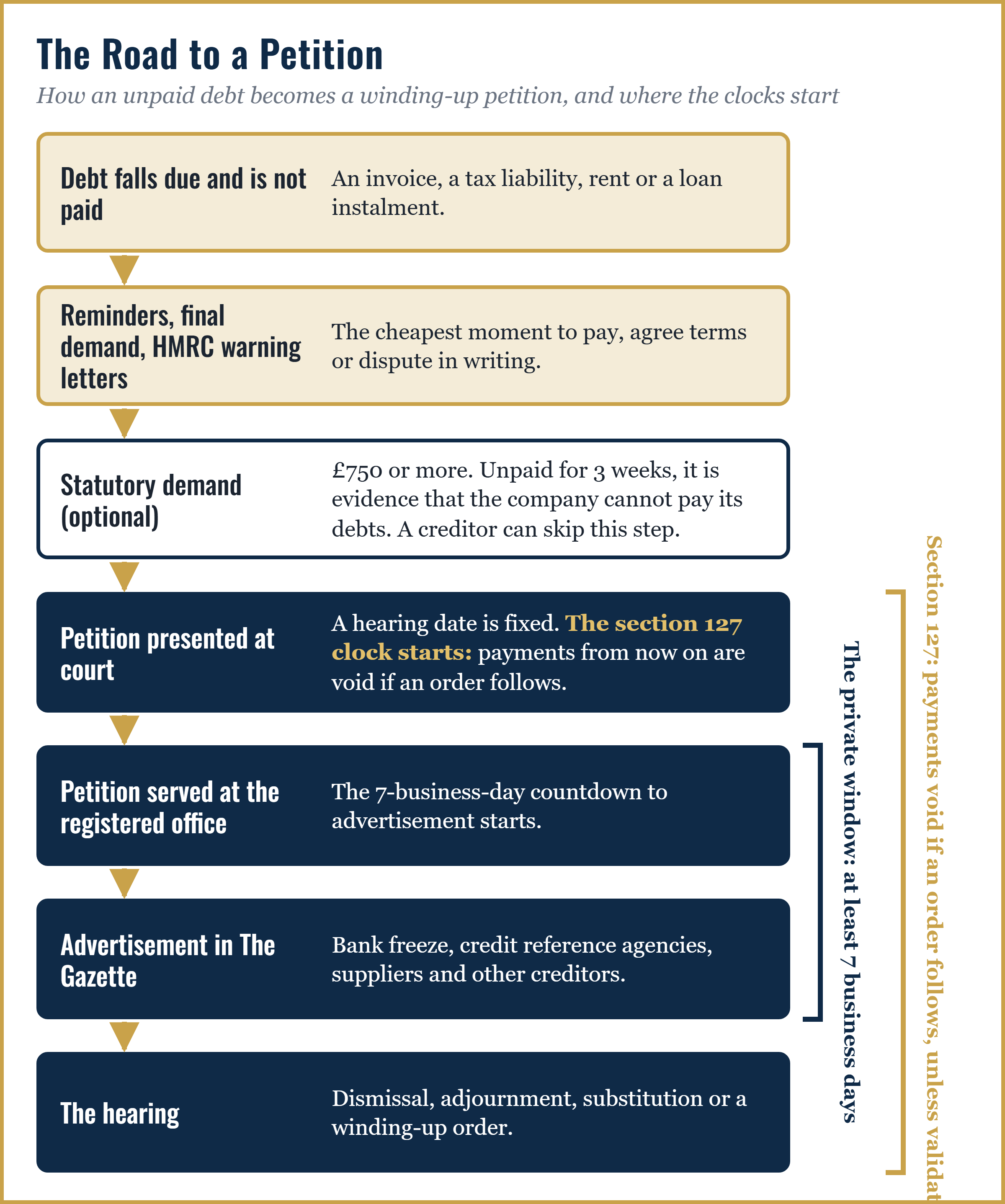
DO NOT pay the petitioning creditor, or anyone else, from the company's account after a petition has been presented without advice. Payments of the company's own money after presentation are void if a winding-up order follows unless the court validates them (section 127). See validation orders.
What happens if the company is wound up
- The leases continue. Each leaseholder still owns their flat on the terms of their lease. A winding-up order does not end the leases.
- Management stops. The liquidator (initially the Official Receiver) takes control of the company. The company's obligations to repair, insure and manage the block are unlikely to be carried out in the ordinary way, and the leaseholders may have to apply to the First-tier Tribunal (Property Chamber) for a manager to be appointed, or set up a new management arrangement.
- The freehold is an asset. If the company owns the freehold, the liquidator must deal with it for the benefit of creditors, which may mean a sale, possibly to an outside investor. Leaseholders who want to keep the freehold should act before an order is made.
- The directors and members lose control. The leaseholders' shares or membership no longer give them a say.
A winding-up order is therefore far more disruptive for the residents than the size of the debt suggests. It is almost always worth resolving before the hearing.
What it means for you as a volunteer director
Most RMC directors are unpaid leaseholders. You are not personally liable for the company's debts as such, but you owe the same duties as any director. Once the company is insolvent, you must act in the interests of its creditors and take every step to minimise their loss (section 214 wrongful trading). In practice that means collecting the service charges properly and not letting the company commit to works it cannot fund. Check whether the company holds directors' and officers' insurance. See my company is insolvent: what are my duties?
 From The Winding-Up Petition Handbook, free for directors.
Key points
- An RMC or RTM company can be wound up like any company for a debt of more than £750 that it cannot pay.
- The leases continue after a winding-up order, but the company's control of the block and any freehold pass to the liquidator.
- The usual solution is valid service charge demands to the leaseholders, and a timetable agreed with the creditor.
- Service charge money is usually held on trust for its purpose under section 42 of the Landlord and Tenant Act 1987.
- Volunteer directors owe the same duties as any director once the company is insolvent.
Frequently asked questions
What happens if our management company goes bust? The leases continue, but a liquidator takes control of the company and any freehold it owns, and the leaseholders may need a tribunal-appointed manager or a new arrangement to keep the block managed.
Is the service charge money safe if the management company is wound up? Usually it is held on a statutory trust to pay the costs it was collected for and then for the leaseholders, rather than for creditors at large, but it depends on the leases and how the money is held.
Are volunteer directors liable for the management company's debts? Not as such, unless a director gave a personal guarantee, but volunteer directors owe the same duties as any director once the company is insolvent.
Can the management company make leaseholders pay to stop the petition? It can demand service charges in accordance with the leases and the statutory rules, and claim arrears; whether it can demand a one-off sum depends on the lease.
Free initial consultation for directors facing a winding-up petition. Call 07361 999123, text DIRAID to 82228, or request a call back.