
A petition is against one company only. Each group company is a separate legal person, so the parent and sister companies are not liable for its debts just by being in the group. The risk comes through links: guarantees, bank facilities with cross-default clauses, a VAT group, intra-group loans, shared staff and premises, and similar names. Directors also ask "is the parent company liable for a subsidiary's debts?", "can a winding-up petition against a subsidiary affect the holding company?" and "can another group company pay the petition debt?". This page explains where the exposure lies and what to do in the first days.
Petition against one of your group's companies? Free initial consultation with a Solicitor: call 07361 999123 or text DIRAID to 82228.
Your free call is with a Solicitor. Have the petition to hand if you can.
Text DIRAID to 82228and we will call you back
Or call us on 07361 999123
First consultation free · No obligation · Nothing to lose
The starting point: separate companies
A parent company is a shareholder in its subsidiaries. As a shareholder it has limited liability: if the subsidiary is wound up, the parent loses the value of its shares, but it does not have to pay the subsidiary's creditors. The same goes for sister companies. A creditor of one company cannot petition against another group company for that debt unless the other company owes it too, for example under a guarantee. See does limited liability protect directors completely?, which explains the same principle for directors.
The exposure comes from the links between the companies. Check each one in the first days.
| Link | Why it matters |
|---|---|
| A parent or cross-guarantee | The guarantor company can be pursued for the debt directly, and may itself face a statutory demand or petition. |
| Group bank facilities | Facility terms often treat a winding-up petition against any group company as an event of default, allowing the bank to demand repayment or stop lending to the whole group. |
| A VAT group | Every member of a VAT group is jointly and severally liable for the group's VAT (section 43 VAT Act 1994). HMRC can look to any member for the group's arrears. |
| Intra-group loans and trading balances | Money the subsidiary is owed by other group companies is an asset its liquidator will collect. Money it owes them makes them creditors. |
| Shared staff, premises and contracts | If the employer, tenant or contracting party is the petitioned company, a winding-up order affects everyone relying on it. |
| Shared or similar names | Directors of the wound-up company can be restricted from using the name in another company (see below). |
The bank account and group cash
When the bank learns of the petition it will usually freeze the petitioned company's account, because payments out of that company's property after presentation are void if an order follows unless the court validates them (section 127). It may also look again at group arrangements such as cash pooling or set-off between accounts. Payments by the petitioned company to other group companies are at particular risk: they are dispositions of its property, and a liquidator will scrutinise them. See winding-up petition and a frozen bank account and validation orders.
DO NOT sweep cash out of the petitioned company into the parent or a sister company. If a winding-up order follows, those transfers are void without a validation order, and they are exactly what a liquidator looks for.
Can another group company pay the debt?
Yes. A parent or sister company can pay the petitioner from its own money to settle the petition, in the same way a director can (see can a director lend the company money to pay a winding-up petition?). Because the money is not the petitioned company's property, the payment is not caught by section 127 in the way a payment from the company's own account would be. Make sure the payment comes directly from the paying company's own account, is documented as a loan or as consideration agreed in writing, and that the paying company can afford it: its directors owe duties to that company and must be satisfied the payment is in its interests. The petition still has to be withdrawn or dismissed with the court's permission, and other creditors may ask to be substituted. See how to stop a winding-up petition.
If the directors sit on more than one board
In most groups the same people are directors of several companies. Your duties are owed to each company separately. Once the petitioned company is insolvent, or likely to become so, its directors must have regard to the interests of its creditors, not the group's. That means a decision that suits the group, such as moving a contract, staff or stock to a sister company, can be a breach of duty to the petitioned company, a transaction at an undervalue or a preference. Take advice before moving anything between companies, and record board decisions for each company separately.
Names: section 216
If the petitioned company is wound up, anyone who was a director of it in the 12 months before liquidation is generally barred for five years from being involved with another company using the same name or one so similar as to suggest a link (section 216 Insolvency Act 1986). In a group this catches sister companies that share part of a name. There are exceptions in the Insolvency Rules, including where the other company has been known by the name for the whole of the 12 months before the liquidation and was not dormant during that time. Check this early. See can I start a new company after liquidation?
If the petition is against the parent
A petition against a holding company is more serious for the group. If an order is made, the liquidator controls the parent's assets, which include its shares in the subsidiaries. The subsidiaries carry on trading as separate companies, but the liquidator, as their shareholder, can sell them or appoint new directors. Group bank facilities are also more likely to be affected.
The options
The usual responses apply to the petitioned company: pay, agree terms, or dispute the debt. A group also has options a single company does not: the parent may fund a settlement, or support a rescue such as administration of the subsidiary with a sale of its business within the group at a proper value. A sale to a connected company has to be at market value and properly advised. See administration to stop a winding-up petition and what to do when you are served.
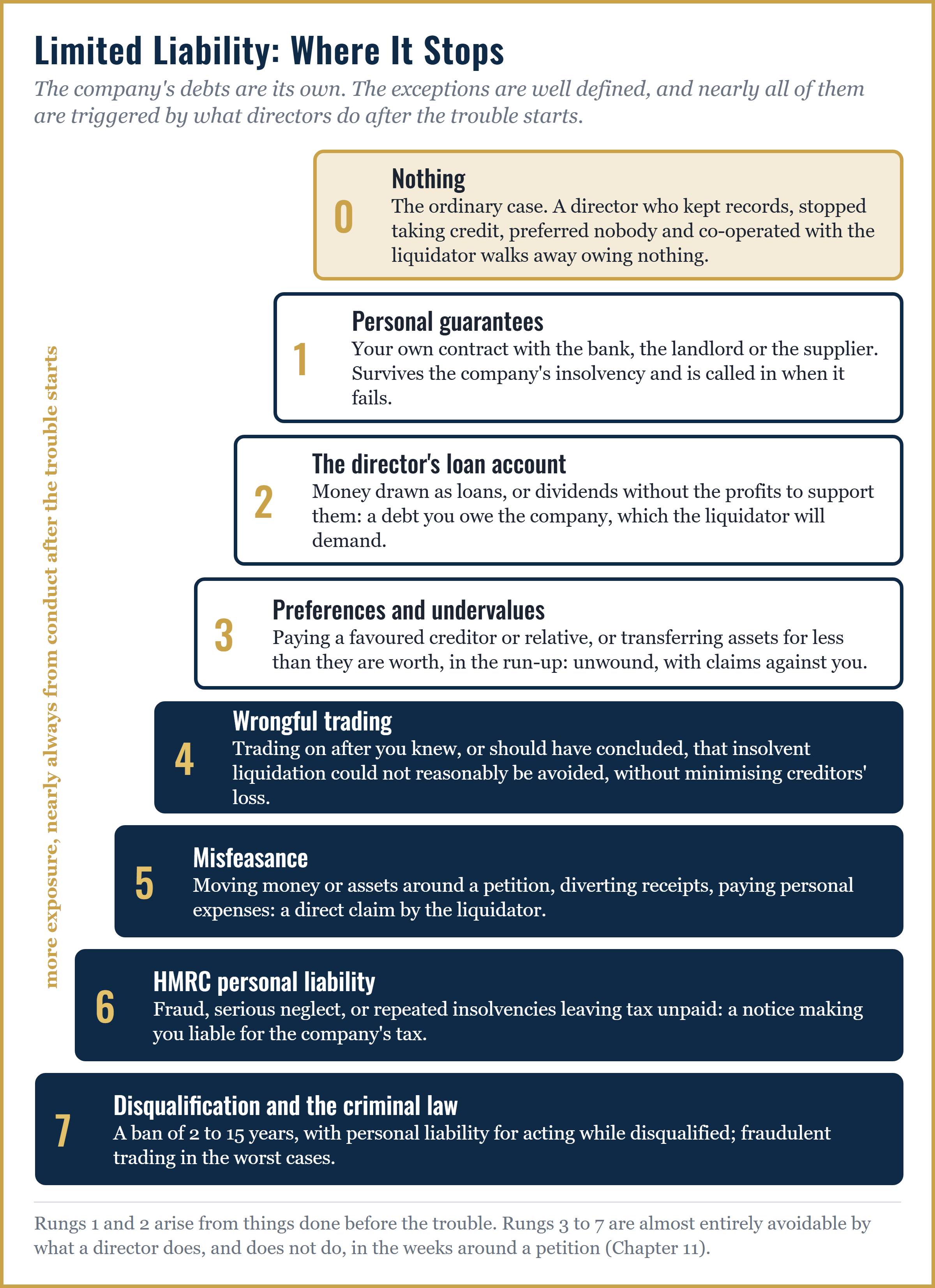 From The Winding-Up Petition Handbook, free for directors.
Key points
- A petition is against one company; the parent and sister companies are not liable for its debts simply by being in the same group.
- Guarantees, cross-default clauses in bank facilities, a VAT group and intra-group balances are where the exposure lies.
- Payments from the petitioned company to other group companies after presentation are void if an order follows, unless validated.
- Another group company can pay the petitioner from its own money, if its own directors are satisfied the payment is in its interests.
- Directors of several group companies owe duties to each separately, and section 216 can restrict similar names after a liquidation.
Frequently asked questions
Is the parent company liable for a subsidiary's debts? Not as a shareholder; it is liable only if it has guaranteed the debt, is jointly liable (for example in a VAT group), or has otherwise taken the debt on.
Can a winding-up petition against a subsidiary affect the holding company? Not directly, but group bank facilities, guarantees and intra-group balances can bring the problem to the parent, so check them in the first days.
Can another group company pay the petition debt? Yes, from its own money, paid directly to the petitioner; the petition must then be withdrawn or dismissed with the court's permission.
Can we move the business to a sister company? Not without advice: once the petitioned company is insolvent its directors must consider its creditors, and a transfer can be void or open to challenge by a liquidator.
Free initial consultation for directors facing a winding-up petition. Call 07361 999123, text DIRAID to 82228, or request a call back.