
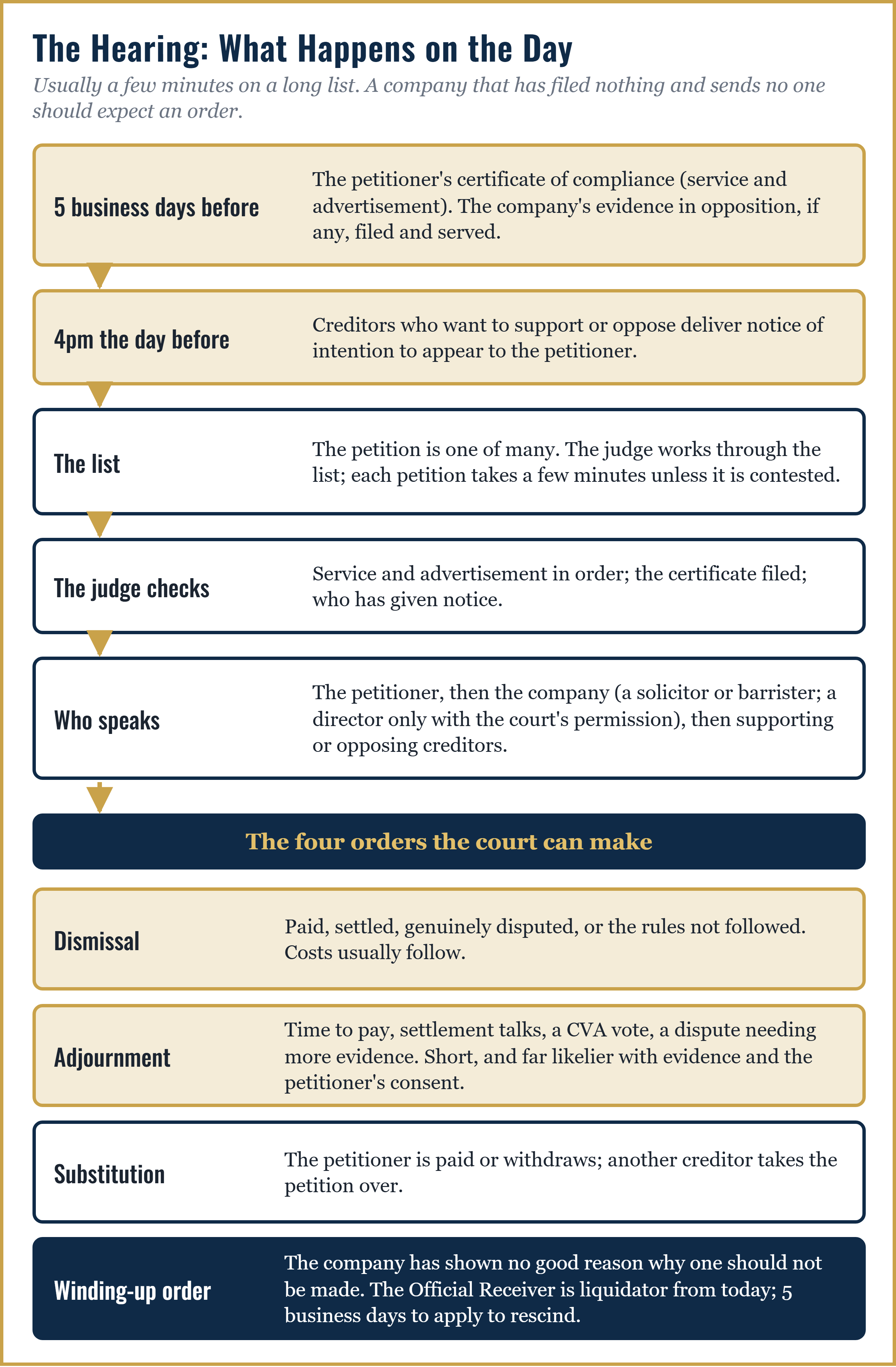
The hearing is usually short, often a few minutes, and is listed alongside many other petitions. The court checks the petition has been properly served and advertised, hears from the petitioner, the company and any other creditors who have given notice, and then dismisses the petition, adjourns it, or makes a winding-up order. A company that wants to oppose must have filed its evidence in advance and be properly represented.
Hearing coming up? Call 07361 999123 for a free initial consultation today.
Your free call is with a Solicitor. Have the petition to hand if you can.
Text DIRAID to 82228and we will call you back
Or call us on 07361 999123
First consultation free · No obligation · Nothing to lose
Where it happens
In the High Court (the Insolvency and Companies List at the Rolls Building in London, or a Business and Property Courts district registry such as Manchester, Leeds, Birmingham, Bristol, Cardiff, Liverpool or Newcastle) or a County Court hearing centre with insolvency jurisdiction. The court and hearing date are on the petition.
Before the hearing
- The petitioner files a certificate of compliance with the rules on service and advertisement.
- Any creditor who wants to support or oppose must deliver notice of intention to appear to the petitioner by 4pm on the business day before the hearing.
- A company opposing the petition must file its evidence at least 5 business days before the hearing.
Who can appear for the company
Usually a solicitor or barrister. A company can be represented by a director or employee only with the court's permission.
What the court can do
| Outcome | When it usually happens |
|---|---|
| Dismiss the petition | The debt is paid, settled or genuinely disputed, or the rules weren't followed |
| Adjourn | Time to pay, settlement talks, or a dispute needing evidence |
| Substitute a petitioner | Another creditor takes over the petition |
| Winding-up order | The company cannot show a good reason not to make one |
If a winding-up order is made
The Official Receiver becomes liquidator, the directors' powers end, and the company's assets are taken under control. An application to rescind the order must be made within 5 business days of the order; the court can extend that time but rarely does. It needs evidence the court did not have at the hearing, usually that the company can pay its debts or that the creditors, including the petitioner, now support rescission. Paying the petitioner alone is not enough. An appeal is a separate route with its own time limit.
From The Winding-Up Petition Handbook, free for directors.
Key points
- Hearings are short; preparation happens beforehand.
- Evidence is due at least 5 business days before the hearing.
- The company normally needs legal representation.
- Options include dismissal, adjournment and substitution.
- Act within days if an order is made.
Frequently asked questions
Do I need to attend? If the company wants to oppose or seek an adjournment, it must be represented.
Can I ask for more time on the day? Possibly, but the court is more likely to adjourn if the request is supported by evidence and the petitioner agrees.
What if no one attends for the company? The court will usually make a winding-up order if the petition is in order.
Prepare for the hearing now. Free initial consultation: 07361 999123 or request a call back.