
No, not for the company's debts alone. HMRC's claim is against the company, and a director's home is the director's own property. A home only becomes exposed if the director first becomes personally liable, through a guarantee, an HMRC notice or a court order, or if the house was given as security or belongs to the company. Directors ask this as "can HMRC take my house if my limited company owes tax?", "can creditors take my home if the company is wound up?" and "is my house safe if my company goes into liquidation?". In most liquidations, it is.
Worried about your home? Free initial consultation with a Solicitor: call 07361 999123 or text DIRAID to 82228.
Your free call is with a Solicitor. Have the petition to hand if you can.
Text DIRAID to 82228and we will call you back
Or call us on 07361 999123
First consultation free · No obligation · Nothing to lose
Why the home is usually safe
A limited company is a separate legal person. When HMRC presents a winding-up petition or proves in a liquidation, it is chasing the company's assets: its bank balance, stock, equipment, debts owed to it and any property it owns. A winding-up order puts the company's assets, not the directors', in the hands of the liquidator. Nothing in a company's liquidation gives HMRC or any other creditor a right to the director's house.
HMRC is the creditor directors meet most often: it presented 57% of the winding-up petitions advertised in England and Wales since October 2023 (Director Aid Petition Figures). But the share of those cases that end with a director's home at risk is small, and it is almost always the result of one of the routes below.
The routes by which a home can become exposed
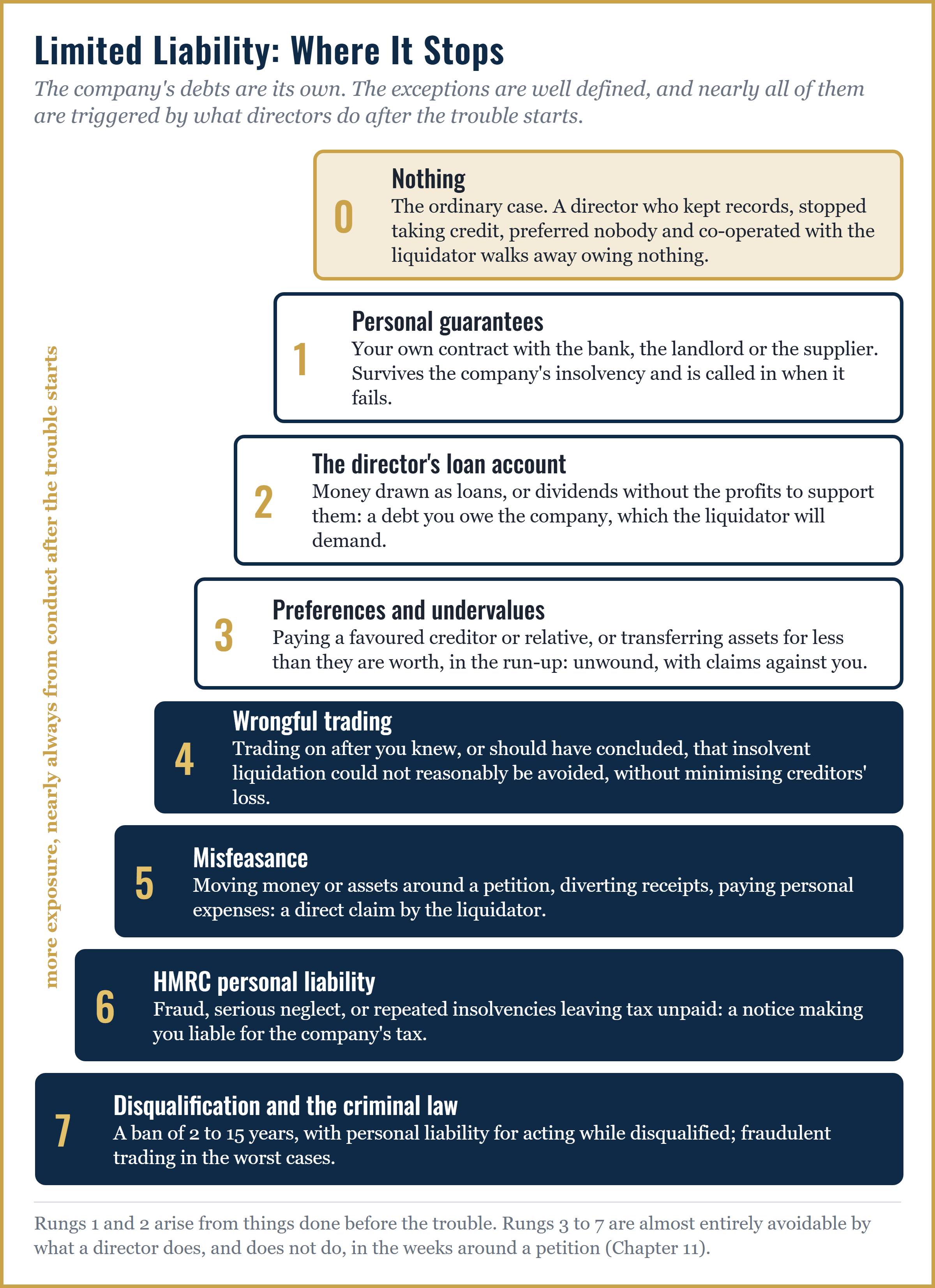
1. A personal debt arises first. For any creditor to go after a home, the director must personally owe money. For a company's debts that happens in a limited number of ways:
- a personal guarantee of a loan, overdraft, lease or supplier account (the most common by far): see personal guarantees after a petition;
- an HMRC personal liability notice for unpaid National Insurance, or a joint and several liability notice making the director liable for the company's tax: see are directors liable for company tax debts?;
- a court order in the liquidation, for example for wrongful trading, misfeasance, or repayment of an overdrawn director's loan account;
- a compensation order after disqualification.
2. The creditor gets a judgment and a charging order. A personal debt still has to be enforced. A creditor with a judgment can apply for a charging order over the debtor's interest in property under the Charging Orders Act 1979. A charging order secures the debt against the home; it does not by itself force a sale. Where the home is jointly owned, the charge is over the director's share only.
3. An order for sale. The creditor can then apply to the court for an order for sale. The court weighs the interests of the creditor against those of the family, including a spouse or partner and children living there, and does not order a sale automatically.
4. Personal insolvency. A creditor owed a large enough personal debt can instead seek the director's bankruptcy, in which case the home is dealt with in that process. This is a separate subject: see a bankruptcy petition against a director.
5. The house is not really the director's. If the house is owned by the company, it is a company asset and the liquidator will sell it. If the director gave a charge over the home to secure a company loan, the lender can enforce that charge in the same way as a mortgage.
HMRC specifically
HMRC has no special power to take a director's home for company tax. It needs one of the personal liability routes above first, and then the same court enforcement as any other creditor. In practice HMRC's personal liability notices are aimed at directors whose neglect or dishonesty caused the tax to go unpaid, and joint and several liability notices at avoidance, evasion and repeated insolvencies through connected companies. A director who filed returns, kept records and took advice when the company could no longer pay is in a very different position.
What to do now
- Find out whether you owe anything personally. List every guarantee you have signed (bank, asset finance, landlord, suppliers) and check your director's loan account.
- DO NOT transfer the house, or your share of it, to a spouse, relative or trust to protect it. A transfer at an undervalue made to put assets beyond creditors' reach can be reversed by the court under section 423 Insolvency Act 1986, which has no fixed look-back period, and doing it makes everything else harder.
- DO NOT take money out of the company to pay down your mortgage or your guaranteed debts while the company cannot pay its creditors; it can be challenged as a preference or misfeasance.
- Deal with the company's position early. The earlier the company stops incurring debt it cannot pay, the less room there is for a wrongful trading claim. Our guide to director liability after a petition sets out each risk.
- If a guarantee is called, respond. A demand under a guarantee can often be negotiated or disputed; see defending a personal guarantee claim.
 From The Winding-Up Petition Handbook, free for directors.
Key points
- HMRC cannot take a director's home for a company's debts alone.
- A home is only at risk once the director personally owes money: a guarantee, an HMRC notice or a court order in the liquidation.
- Even then the creditor needs a judgment, a charging order and usually an order for sale, and the court considers the family.
- A home owned by the company, or charged to secure a company loan, is a different matter.
- DO NOT transfer the home to protect it; it can be reversed and makes matters worse.
Frequently asked questions
Can creditors take my house if my limited company is wound up? Not because of the winding-up. They can only pursue your home if you personally owe them money, for example under a personal guarantee, and then only through the courts.
Can HMRC put a charge on my house for company VAT or PAYE? Only if you have been made personally liable for that tax, for example by a personal liability notice or a joint and several liability notice, and HMRC then obtains a judgment and a charging order.
Should I put my house in my spouse's name? No. A transfer to put assets beyond creditors' reach can be set aside by the court, and it can be used as evidence against you in any claim or investigation.
Is a jointly owned home treated differently? A charging order against one owner attaches to that owner's share, and the court must consider the other owner's interests before ordering a sale.
Free initial consultation: your company and your home. Call 07361 999123, text DIRAID to 82228, or request a call back.