
Usually not. A company's tax debts are the company's own, and HMRC cannot simply send the bill to a director. But HMRC, a liquidator or the Insolvency Service can reach a director personally in defined situations, most of them turning on how the director behaved while the tax went unpaid. The same question is often asked as "can HMRC chase a director for company VAT?", "am I liable for PAYE if my limited company goes bust?" and "does unpaid corporation tax become my debt?". The answer to all three starts from the same rule and the same exceptions.
HMRC chasing the company, or you? Free initial consultation with a Solicitor: call 07361 999123 or text DIRAID to 82228.
Your free call is with a Solicitor. Have the petition to hand if you can.
Text DIRAID to 82228and we will call you back
Or call us on 07361 999123
First consultation free · No obligation · Nothing to lose
The starting point
A limited company is a separate legal person. PAYE, employees' and employer's National Insurance, VAT and corporation tax are all owed by the company. If the company goes into liquidation unable to pay them, HMRC proves in the liquidation like any other creditor (with limited preferential status for some taxes the company collected on its behalf, such as VAT and PAYE) and, in the ordinary case, the shortfall is written off. A director who ran the company honestly, kept proper records and filed returns does not inherit the tax bill. See does limited liability protect directors completely?
HMRC is also the creditor most likely to petition: it presented 57% of the winding-up petitions advertised in England and Wales since October 2023, according to the Director Aid Petition Figures. So the tax question usually arrives alongside an HMRC petition: see HMRC winding-up petitions.
When HMRC can make a director pay
Personal liability notices for National Insurance. Under section 121C of the Social Security Administration Act 1992, HMRC can serve a notice on a director (or other officer) requiring them to pay unpaid National Insurance contributions where the company's failure to pay is attributable to the fraud or neglect of that officer. "Neglect" is the point that catches directors: for example, continuing to pay staff net wages and other creditors while deliberately leaving the National Insurance unpaid over a long period. A notice can be appealed, and should be answered with evidence of what the director actually knew and did.
Joint and several liability notices. Since 2020, HMRC has had power under the Finance Act 2020 to make a director or certain shareholders jointly and severally liable for a company's tax where the company is in, or likely to enter, an insolvency procedure and there has been tax avoidance, tax evasion, or a pattern of repeated insolvency and non-payment of tax through connected companies (commonly called phoenixism). These notices are aimed at deliberate conduct, not ordinary business failure, but they apply to all taxes, including VAT and corporation tax, and the conditions are technical. Advice on whether they are met should come early.
Penalties for deliberate inaccuracies. Where a company's return contains a deliberate inaccuracy that is attributable to an officer who gained from it, HMRC can in some cases require that officer to pay part or all of the company's penalty. This applies to penalties, not to the underlying tax.
The director's own PAYE. Where a director knew that the company was wilfully failing to deduct tax from the director's own pay, HMRC can in some circumstances collect that tax from the director rather than the company.
When someone other than HMRC makes a director pay
Most personal exposure for tax debts arises not from HMRC directly but from the liquidation:
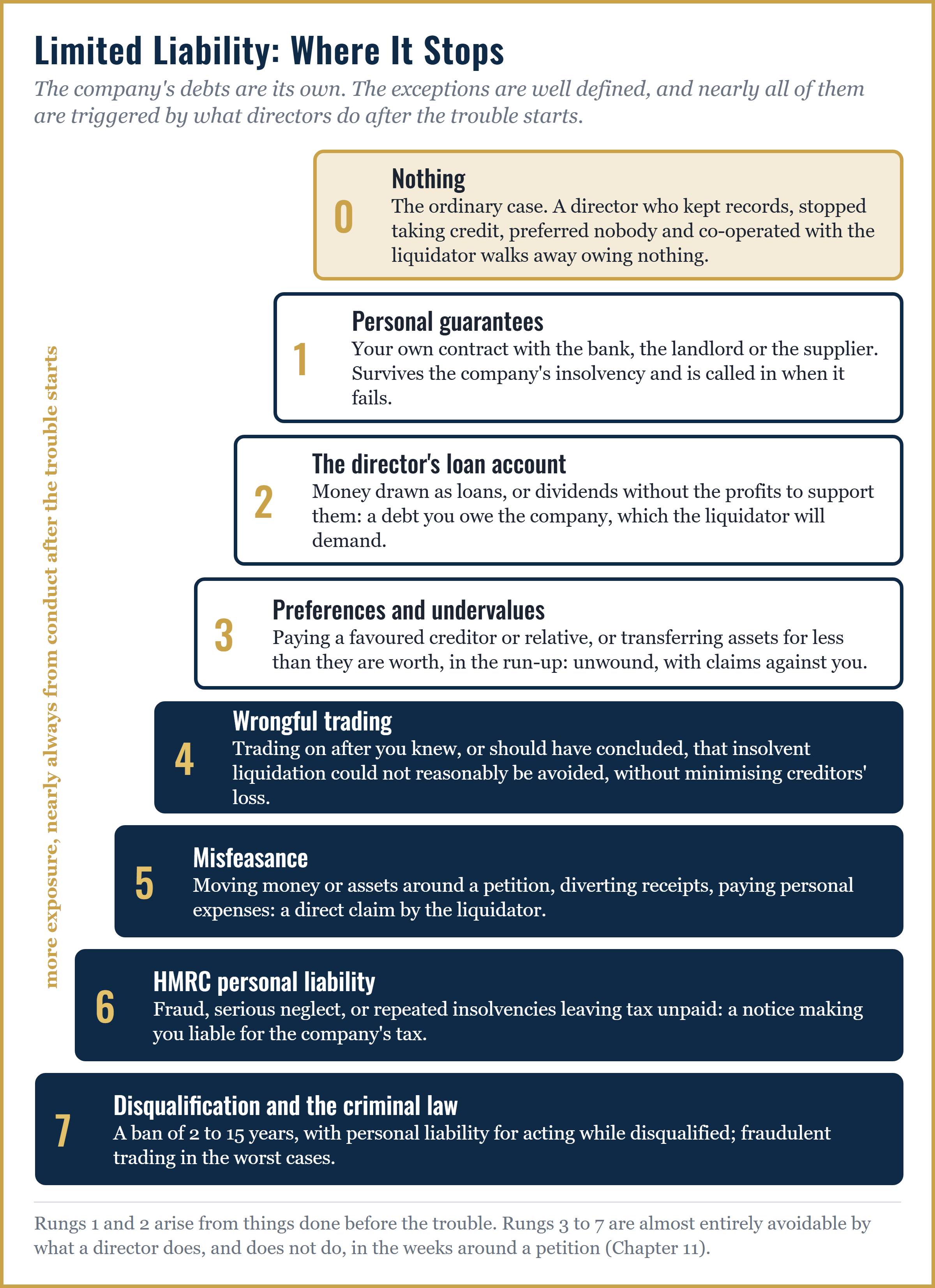
- Wrongful trading. If the company kept trading after the point at which a director knew, or ought to have concluded, that insolvent liquidation or administration could not reasonably be avoided, the court can order the director to contribute to the company's assets (section 214 Insolvency Act 1986). Mounting HMRC arrears are often the evidence of when that point was reached. See wrongful trading.
- Preferences. Paying other creditors, or repaying a director's own loan, while HMRC went unpaid can be challenged as a preference. See preferences.
- The director's loan account. An overdrawn loan account is an asset of the company, and the liquidator will collect it for the creditors, of whom HMRC is often the largest. See overdrawn director's loan account.
- Misfeasance and compensation orders. A liquidator can claim against a director for breach of duty (section 212), and a disqualified director can be ordered to compensate creditors (section 15A Company Directors Disqualification Act 1986). Treating unpaid tax as working capital is a recurring feature of disqualification cases.
- Personal guarantees. HMRC does not normally take personal guarantees for tax, but a director who guaranteed a loan or overdraft that was used to pay HMRC stays liable to the lender. See personal guarantees after a petition.
What does not make you liable
- Being a director when the debt arose, without more.
- The company going into liquidation, or a winding-up order being made.
- HMRC presenting a winding-up petition against the company.
- Signing returns that were correct but could not be paid.
The question in every case is conduct: what the director knew, when, and what they did about it.
What to do now
- Keep filing. File every return on time even if the tax cannot be paid. Late or missing returns are treated as a sign of deliberate non-compliance and make HMRC far less flexible.
- Stop the gap growing. Taking more PAYE and VAT from customers and staff without paying it over is exactly what personal liability notices and disqualification are aimed at.
- DO NOT pay other creditors or yourself in preference to HMRC once the company cannot pay everyone; take advice first.
- DO NOT move assets out of the company or transfer personal property to protect it; see can HMRC take my house?
- Record decisions. Board minutes and cash-flow forecasts showing that you took advice and acted on it are the best defence to every claim above.
- Talk to HMRC before a petition. A Time to Pay arrangement is realistic before HMRC goes to court and rare afterwards: see Time to Pay to stop an HMRC petition.
 From The Winding-Up Petition Handbook, free for directors.
Key points
- Company tax debts belong to the company; a director is not liable just for being a director.
- HMRC can serve personal liability notices for National Insurance where non-payment results from a director's fraud or neglect.
- Joint and several liability notices can make a director liable for any tax where there has been avoidance, evasion or repeated insolvency.
- Most personal exposure comes through the liquidator: wrongful trading, preferences, the loan account and misfeasance.
- Keep filing, stop the arrears growing and take advice before HMRC presents a petition.
Frequently asked questions
Can HMRC chase me personally for my company's VAT? Not for the VAT itself in the ordinary case. It can where a joint and several liability notice applies, and in some cases it can transfer penalties for deliberate inaccuracies to the officer responsible.
Am I liable for unpaid PAYE if my limited company goes into liquidation? Not automatically. National Insurance can be passed to a director by a personal liability notice where non-payment results from the director's fraud or neglect, and a liquidator may bring claims where other creditors were paid while HMRC was not.
Does unpaid corporation tax become the director's debt? No, unless a joint and several liability notice applies or a court orders the director to contribute in the liquidation.
Can HMRC make me pay after the company is dissolved? HMRC's direct powers depend on the notices described above. Dissolution does not by itself transfer the company's tax debts to its directors.
Free initial consultation for directors facing HMRC. Call 07361 999123, text DIRAID to 82228, or request a call back.