
Creditors' voluntary liquidation, administration, a company voluntary arrangement and the standalone moratorium: what each does to a pending petition, side by side. This is Chapter 13 of The Winding-Up Petition Handbook, the free book for directors by Alastair Redfern LL.B., Solicitor, published by Director Aid. Download the whole book free, or read on.
← Previous: Is There a Petition Against My Company? · All chapters · Next: Three Worked Examples →
A petition is not the only road into insolvency, and it is often not the best one. This chapter sets out briefly the procedures a company facing a petition may need to consider, and how a pending petition affects each. Director Aid deals with all of them.
Creditors' Voluntary Liquidation (CVL)
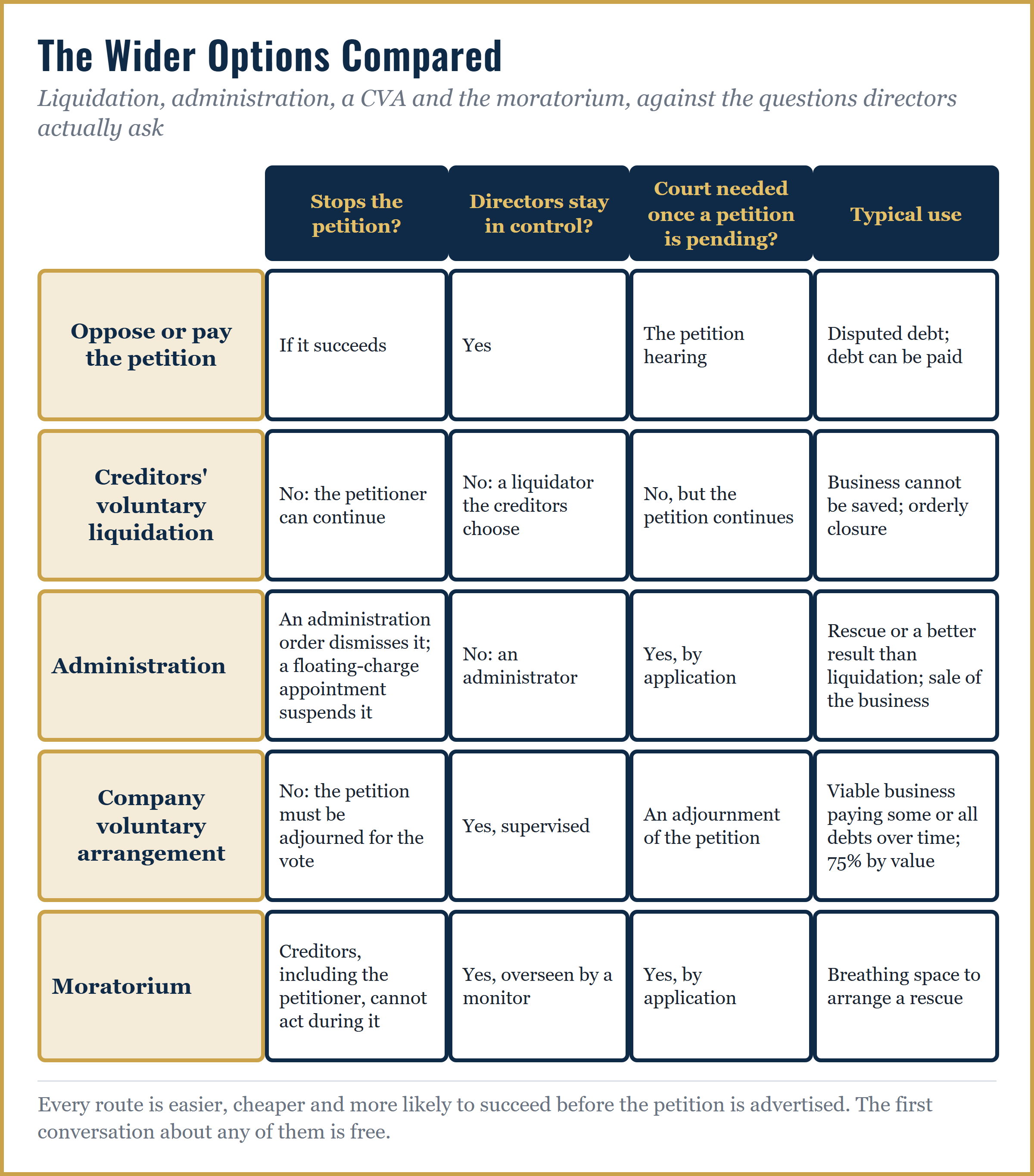
The company's shareholders resolve to wind the company up and the creditors appoint a licensed insolvency practitioner as liquidator. It is quicker and more orderly than a compulsory liquidation, the directors choose the liquidator, and it is usually the right course for a company that cannot be saved. A pending petition does not prevent a CVL, but it does not end the petition either: the petitioner can continue and the court can still make a winding-up order, in which case the Official Receiver takes over. Where a petition is pending, the timing and the petitioner's position need careful handling.
Administration
An administrator, a licensed insolvency practitioner, takes control of the company with the aim of rescuing it, achieving a better result for creditors than a liquidation, or realising property for secured or preferential creditors. Administration brings a moratorium on creditor action. Ordinarily a company or its directors can appoint an administrator out of court by filing notice. Once a winding-up petition has been presented, that route is closed: the company and its directors must apply to the court for an administration order (a lender holding a qualifying floating charge can still appoint out of court). If an administration order is made, the petition is dismissed. A pre-packaged sale of the business through administration can be arranged in parallel.
Company Voluntary Arrangement (CVA)
A binding arrangement with creditors to pay some or all of the debts over time, proposed by the directors and supervised by an insolvency practitioner. It needs the support of 75% by value of the creditors who vote. A CVA can be proposed while a petition is pending, but the petition will need to be adjourned to allow the creditors to vote, and the petitioner's attitude matters.
The Standalone Moratorium
The Corporate Insolvency and Governance Act 2020 created a moratorium, overseen by a monitor, during which creditors cannot take action while the directors seek a rescue. Where no petition is pending, the directors can obtain it by filing papers at court. Once a petition is pending, a moratorium can only be obtained by applying to the court. The proposed monitor must still confirm that the moratorium is likely to result in the rescue of the company as a going concern, and the court must also be satisfied that a moratorium would achieve a better result for the creditors as a whole than a winding-up without one.
The Routes Side by Side
| Route | Who starts it | What it does to a pending petition | Who is in charge | When it is used |
|---|---|---|---|---|
| Compulsory liquidation (the petition itself) | A creditor, by petition | It is the petition | The Official Receiver, then possibly an insolvency practitioner | The company cannot pay and nobody acts |
| Creditors' voluntary liquidation | The shareholders, with the creditors choosing the liquidator | Does not end the petition; the petitioner can continue | A liquidator chosen by the creditors | The business cannot be saved and the directors want an orderly close |
| Administration | The company or directors (by court order once a petition is pending); a qualifying floating charge holder (out of court) | An administration order dismisses the petition; an appointment by a floating charge holder suspends it | An administrator | The business, or part of it, can be rescued or sold as a going concern |
| Company voluntary arrangement | The directors, with an insolvency practitioner as nominee | Does not end the petition; the petition must be adjourned for creditors to vote | The directors, supervised by an insolvency practitioner | The business is viable if the debts can be rescheduled or reduced |
| Moratorium | The directors (by court order once a petition is pending) | Creditors, including the petitioner, cannot take action during it | The directors, overseen by a monitor | Breathing space to arrange a rescue |
Whatever the right route is, the first conversation is free. Text DIRAID to 82228, call 07361 999123 or book at directoraid.co.uk.
Your free call is with a Solicitor. Have the petition to hand if you can.
Text DIRAID to 82228and we will call you back
Or call us on 07361 999123
First consultation free · No obligation · Nothing to lose
Choosing
The right route depends on whether the business is viable, who the creditors are, what the directors have guaranteed and what time is left. The one thing every route has in common is that it is easier, cheaper and more likely to succeed before the petition is advertised.
← Previous: Is There a Petition Against My Company? · All chapters · Next: Three Worked Examples →
Citation: Redfern, A., The Winding-Up Petition Handbook: A Director's Guide to Petitions, Deadlines, Frozen Bank Accounts and the Options That Remain, Director Aid, First Edition, October 2026. Chapter 13, The Wider Options: Liquidation, Administration, CVA and Moratorium.
Free initial consultation for directors facing a winding-up petition. Call 07361 999123, text DIRAID to 82228, or request a call back.