
What a validation order is, when a company needs one, the types of order, what the court looks for, the evidence required and how fast an order can be obtained. This is Chapter 6 of The Winding-Up Petition Handbook, the free book for directors by Alastair Redfern LL.B., Solicitor, published by Director Aid. Download the whole book free, or read on.
← Previous: The Bank Account · All chapters · Next: Disputed Debts →
What a Validation Order Is
A validation order is an order of the court under section 127 permitting a company that faces a winding-up petition to make particular payments, or to continue trading, despite the petition. Payments covered by the order are not void if a winding-up order follows, so banks will process them.
When You Need One
- The bank has frozen the account.
- Staff, rent or key suppliers must be paid for the business to survive.
- The company wants to sell an asset or complete a contract.
- The company is opposing the petition and must trade until the hearing.
Types of Order
- For a specific transaction: one payment, or one sale.
- For continued trading: ordinary trading through the account for a set period, often until the hearing.
- Retrospective: the court can validate payments already made, but it is noticeably harder to obtain and should not be relied on.
What the Court Looks For
The central question is whether the proposed payments benefit the general body of unsecured creditors, or at least do not prejudice them. The court will want to be satisfied that:
- the company is solvent and able to pay its debts as they fall due, or that the particular payments will benefit, or at least not prejudice, the unsecured creditors as a whole;
- the payments are made in good faith in the ordinary course of business;
- no creditor is being preferred over the others; and
- the directors have given full and frank disclosure of the company's position.
The Evidence
The court's Insolvency Practice Direction sets out what is expected. Typically the application is supported by a witness statement from a director exhibiting:
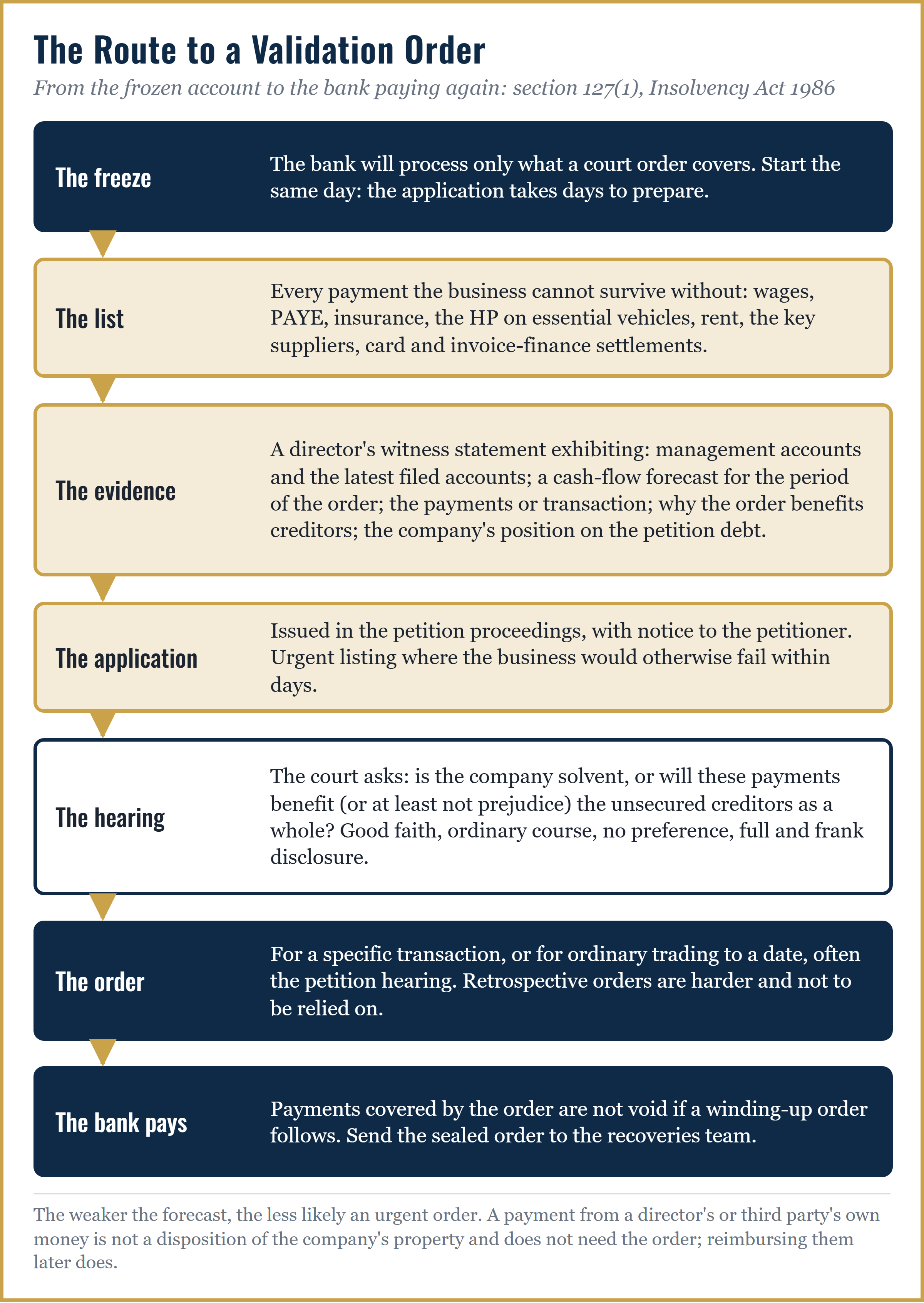
- up-to-date management accounts and the latest filed accounts;
- a cash-flow forecast covering the period of the proposed order;
- details of the payments or the transaction to be validated;
- an explanation of why the order benefits creditors; and
- the company's position on the petition debt.
The petitioner should be notified of the application.
How Fast
Applications can be heard urgently where the business would otherwise fail within days. The weaker the evidence, the less likely an urgent order is: a judge asked to act within hours needs a forecast that holds together.
A Common Question
Can a director pay the petition debt personally? A payment from the director's own funds is not a disposition of the company's property, so section 127 does not catch it in the same way. The documentation matters, and the company must not reimburse the director while the petition is pending. See Chapter 8.
← Previous: The Bank Account · All chapters · Next: Disputed Debts →
Citation: Redfern, A., The Winding-Up Petition Handbook: A Director's Guide to Petitions, Deadlines, Frozen Bank Accounts and the Options That Remain, Director Aid, First Edition, October 2026. Chapter 6, Validation Orders.
Free initial consultation for directors facing a winding-up petition. Call 07361 999123, text DIRAID to 82228, or request a call back.
Your free call is with a Solicitor. Have the petition to hand if you can.
Text DIRAID to 82228and we will call you back
Or call us on 07361 999123
First consultation free · No obligation · Nothing to lose