
The proceedings a director meets beyond the petition itself: restraining the petition, judgments, construction adjudication awards, the landlord's remedies, claims on guarantees and the liquidator's claims against directors, with where each is decided and how it bears on the petition. This is Chapter 17 of The Winding-Up Petition Handbook, the free book for directors by Alastair Redfern LL.B., Solicitor, published by Director Aid. Download the whole book free, or read on.
← Previous: Questions Directors Ask · All chapters · Next: What the Figures Say →
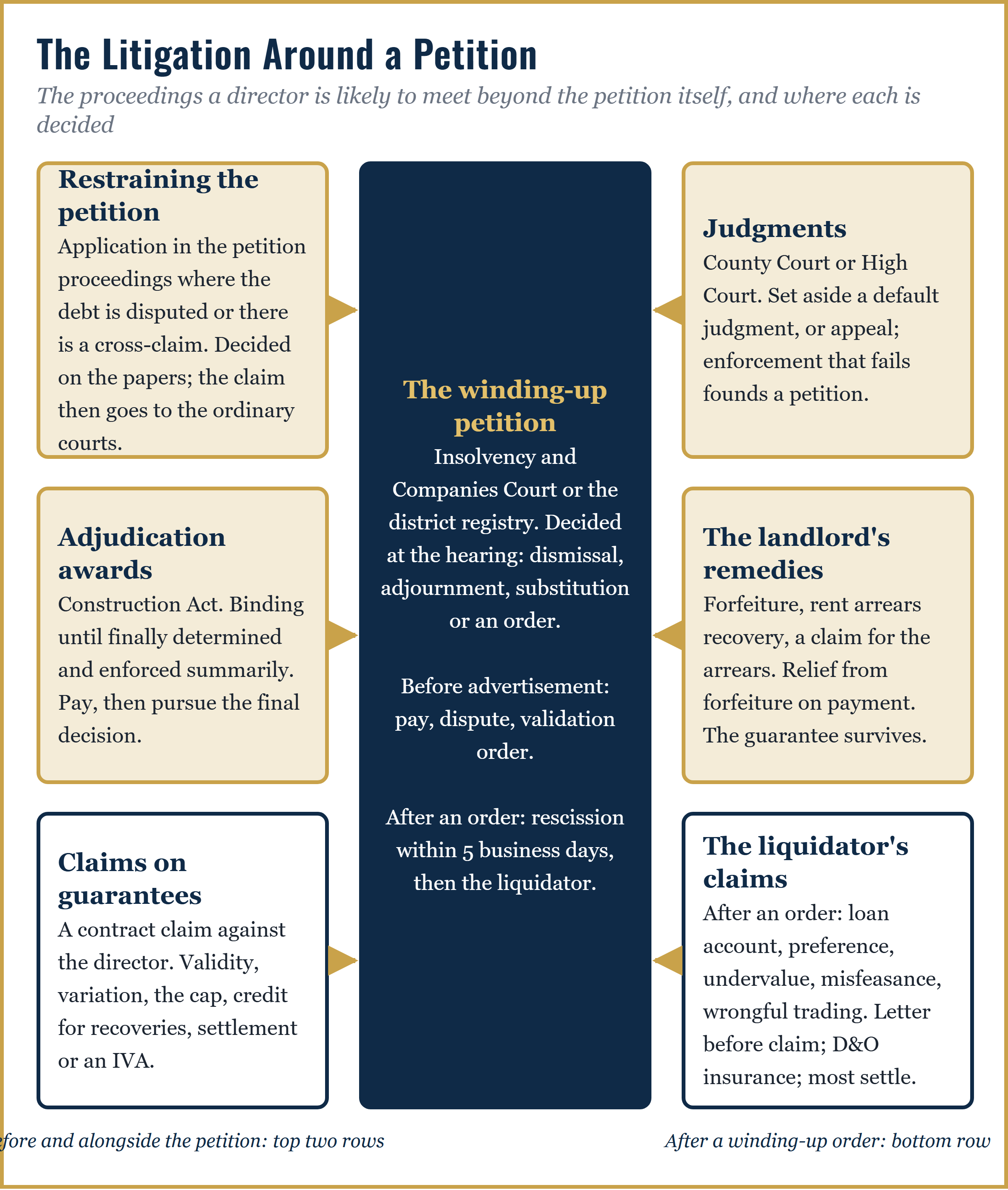
A petition rarely arrives alone. Behind it there is usually a claim, a judgment, an award or a lease, and after it there may be claims against the directors personally. This chapter sets out the proceedings a director is likely to meet beyond the petition itself, where each is decided, and how each bears on the petition. The diagram shows them together.
Restraining the Petition
Where the debt is genuinely disputed on substantial grounds, or the company has a real cross-claim of at least the same amount, the company applies to the court for an order restraining advertisement and dismissing the petition; before a petition exists, the application is for an injunction restraining the creditor from presenting one. The application is supported by a director's witness statement with the contemporaneous documents, and the petitioner is asked for an undertaking not to advertise before it is heard. The court does not decide the dispute; it decides whether winding-up proceedings are the wrong place for it. If they are, the petition is dismissed, usually with costs against the petitioner, and the creditor is left to an ordinary claim in the County Court or the High Court, where the company's defence and cross-claim are decided properly. Where part of the debt is undisputed and would itself found a petition, that part must be paid first.
Judgments
A judgment is the strongest footing for a petition, because the dispute has already been decided. A judgment entered in default, without the company's involvement, can be set aside if the application is made promptly and the company has a real prospect of defending; a judgment after a hearing can only be appealed, with permission and within the time limit. A credible set-aside application or appeal is a ground for adjourning a petition, but the court will usually want to know that the company can pay if it fails. A judgment creditor also has enforcement: taking goods, charging orders, third-party debt orders. An enforcement returned unsatisfied is itself a ground for a petition.
Adjudication Awards
In construction, an adjudicator's decision is binding until the dispute is finally decided, and the courts enforce it summarily. A petition founded on an unpaid award is very hard to resist on the ground that the award is wrong: the only grounds are that the adjudicator lacked jurisdiction or acted unfairly, that the award has been paid or set off against a later decision, or a genuine cross-claim that could not have been raised in the adjudication. A contractor that disputes an award should pay it and pursue the final determination. The chain is not a defence: non-payment by the employer upstream is a claim against the employer, not against the petitioning supplier.
The Landlord's Remedies
A landlord with unpaid rent can forfeit the lease by re-entry or proceedings, take goods under commercial rent arrears recovery, sue for the arrears, and petition, and may use more than one. A petition does not prevent forfeiture; forfeiture does not end the debt; and exercising rent arrears recovery affirms the lease so that the landlord cannot then forfeit for the same arrears. A tenant can apply for relief from forfeiture, usually granted on payment of the arrears and costs, if it acts promptly. A director who guaranteed the lease remains liable throughout, and the guarantee shapes whether the premises are worth fighting for.
Claims on Guarantees
A guarantee is a contract and is defended on its terms: whether it was validly signed; whether the facility was varied without the guarantor's consent in a way the guarantee does not permit; whether the claim exceeds a cap; whether it was procured by a misrepresentation; whether the creditor has given credit for what it recovered from the company and its security; set-off; and limitation. Most guarantee claims are settled, because a creditor pursuing a guarantor to bankruptcy recovers little, and a lump-sum settlement with a written release is commonly accepted. Chapter 11 deals with the director's wider options.
The Liquidator's Claims
After a winding-up order the director may face claims by the liquidator: for an overdrawn loan account, for a preference or a transaction at an undervalue, for misfeasance, or for wrongful trading. Each has its own elements and defences; all turn on documents and dates. The first step is usually a letter before claim, which should be answered through advice, with the documents, within the time given. The company may have had directors' and officers' insurance that covers defence costs; notify the insurer at once. Most claims settle once each side has seen the other's evidence. A settlement does not of itself prevent disqualification proceedings on the same facts, but engagement and compensation of the estate count in the director's favour.
The Common Thread
Every one of these proceedings is decided on the documents and the dates, and in every one the director who kept records, acted promptly and took advice is in a far stronger position than the one who did not. The petition is the centre of the picture, and dealing with it in the days before advertisement usually settles much of what surrounds it.
Facing a claim as well as the petition? The free initial consultation covers both. Call 07361 999123 or text DIRAID to 82228.
Your free call is with a Solicitor. Have the petition to hand if you can.
Text DIRAID to 82228and we will call you back
Or call us on 07361 999123
First consultation free · No obligation · Nothing to lose
← Previous: Questions Directors Ask · All chapters · Next: What the Figures Say →
Citation: Redfern, A., The Winding-Up Petition Handbook: A Director's Guide to Petitions, Deadlines, Frozen Bank Accounts and the Options That Remain, Director Aid, First Edition, October 2026. Chapter 17, The Litigation Around a Petition.
Free initial consultation for directors facing a winding-up petition. Call 07361 999123, text DIRAID to 82228, or request a call back.