
Yes. A members' voluntary liquidation (MVL) does not stop a creditor asking the court to wind the company up (section 116 Insolvency Act 1986). But a creditor of a truly solvent company in MVL should be paid in full with interest, so the court needs a good reason, usually that the company is not in fact solvent. Directors also ask "can HMRC wind up a company in MVL?", "what happens if a creditor appears after the MVL starts?" and "what if the declaration of solvency was wrong?". This page explains the answers and what they mean for you.
Petition against a company in MVL? Free initial consultation with a Solicitor: call 07361 999123 or text DIRAID to 82228.
Your free call is with a Solicitor. Have the petition to hand if you can.
Text DIRAID to 82228and we will call you back
Or call us on 07361 999123
First consultation free · No obligation · Nothing to lose
What an MVL is, and why it matters here
An MVL is a solvent liquidation. The directors make a statutory declaration of solvency (section 89) stating that the company will pay its debts in full, with interest, within a stated period of no more than twelve months, and the shareholders resolve to wind up. The liquidator is chosen by the shareholders. MVLs are common: about 638 solvent companies a month in England and Wales were closed this way in the twelve months to October 2026 (Director Aid Petition Figures).
Because an MVL promises to pay creditors in full, a creditor normally just proves its debt to the liquidator and is paid, with statutory interest from the date the liquidation began. A petition is the exception, and usually means something has gone wrong.
Who can petition, and what the court looks at
| Petitioner | Can it petition? | What the court looks for |
|---|---|---|
| A creditor | Yes (section 116) | A good reason to prefer a compulsory liquidation, usually that the company cannot pay in full or that the creditor's claim is not being dealt with fairly |
| A shareholder | Yes (section 116) | That the shareholders' rights will be prejudiced by the voluntary liquidation continuing |
| The Official Receiver | Yes (section 124(5)) | That the voluntary liquidation cannot be continued with due regard to the interests of creditors or shareholders |
A creditor's petition still needs a debt of more than £750 and proof that the company is unable to pay its debts. If the company really is solvent and the liquidator is ready to pay, the court is unlikely to make an order: a petition is not the right way to collect a debt the liquidator will pay anyway.
Why a creditor would petition against a company in MVL
- The company is not in fact solvent. A large liability was left out of the declaration of solvency, such as a tax assessment, a dilapidations claim, a guarantee or litigation.
- The claim has been rejected. The liquidator has refused the creditor's proof. The usual remedy here is an application to the court to reverse the liquidator's decision on the proof under the Insolvency Rules, not a petition, but a creditor may use a petition where it says the company cannot pay.
- Assets were distributed too early. Money was paid out to shareholders before all creditors were dealt with.
- Independence. The creditor wants the Official Receiver to investigate, for example where the company's business or assets went to a connected company shortly before the liquidation.
HMRC is the creditor most likely to appear late in an MVL, with an enquiry or assessment that was open when the liquidation started. HMRC presented 57% of the petitions advertised since November 2023 (Director Aid Petition Figures).
If the declaration of solvency was wrong
If the liquidator forms the opinion that the company will not be able to pay its debts in full, with interest, within the period stated in the declaration, the liquidator must tell the creditors and the MVL becomes a creditors' voluntary liquidation (sections 95 and 96). The creditors can then choose their own liquidator. This often happens without any petition. A creditor may still petition if it wants a compulsory liquidation instead; see can a creditor wind up a company already in CVL?.
DO NOT make a declaration of solvency without reasonable grounds for the opinion that the company can pay all its debts in full. It is a criminal offence to do so (section 89(4)). Where the winding-up resolution follows within five weeks of the declaration and the debts are not paid or provided for in full within the stated period, it is presumed that you did not have reasonable grounds unless you show otherwise (section 89(5)).
What happens if an order is made
The voluntary liquidator leaves office and the Official Receiver becomes liquidator. The winding up is treated as having begun on the date of the shareholders' resolution, so the look-back periods for preferences and transactions at an undervalue run from that earlier date. The Official Receiver investigates the company's affairs and the directors' conduct, as in every compulsory liquidation. See what happens to directors in liquidation.
What directors should do
- Check the creditor's claim. Is it a real debt, and was it known when the declaration was made? Gather the documents.
- Talk to the liquidator. If the debt is due and the company can pay, the simplest answer is for the liquidator to pay it with statutory interest and ask the petitioner to withdraw (withdrawal needs the court's permission).
- Look at distributions. If money has already gone to shareholders and the company can no longer pay, shareholders may have to repay what they received, and directors may face questions about the declaration.
- Take advice early if the company may not be able to pay in full, before conversion or a hearing.
DO NOT ignore a petition because the company is already in liquidation. If the court is satisfied the company cannot pay its debts and there is no answer from the company or the liquidator, it can make a winding-up order.
What it means for you as a director
A petition against a company in MVL usually puts the declaration of solvency in question. If the company turns out to be insolvent, you may face an investigation, claims over payments made before the liquidation, and questions about whether the declaration was made on reasonable grounds. Shareholders who received distributions may be asked to return them. See can a liquidator sue me as a director? and am I personally liable after a winding-up petition?.
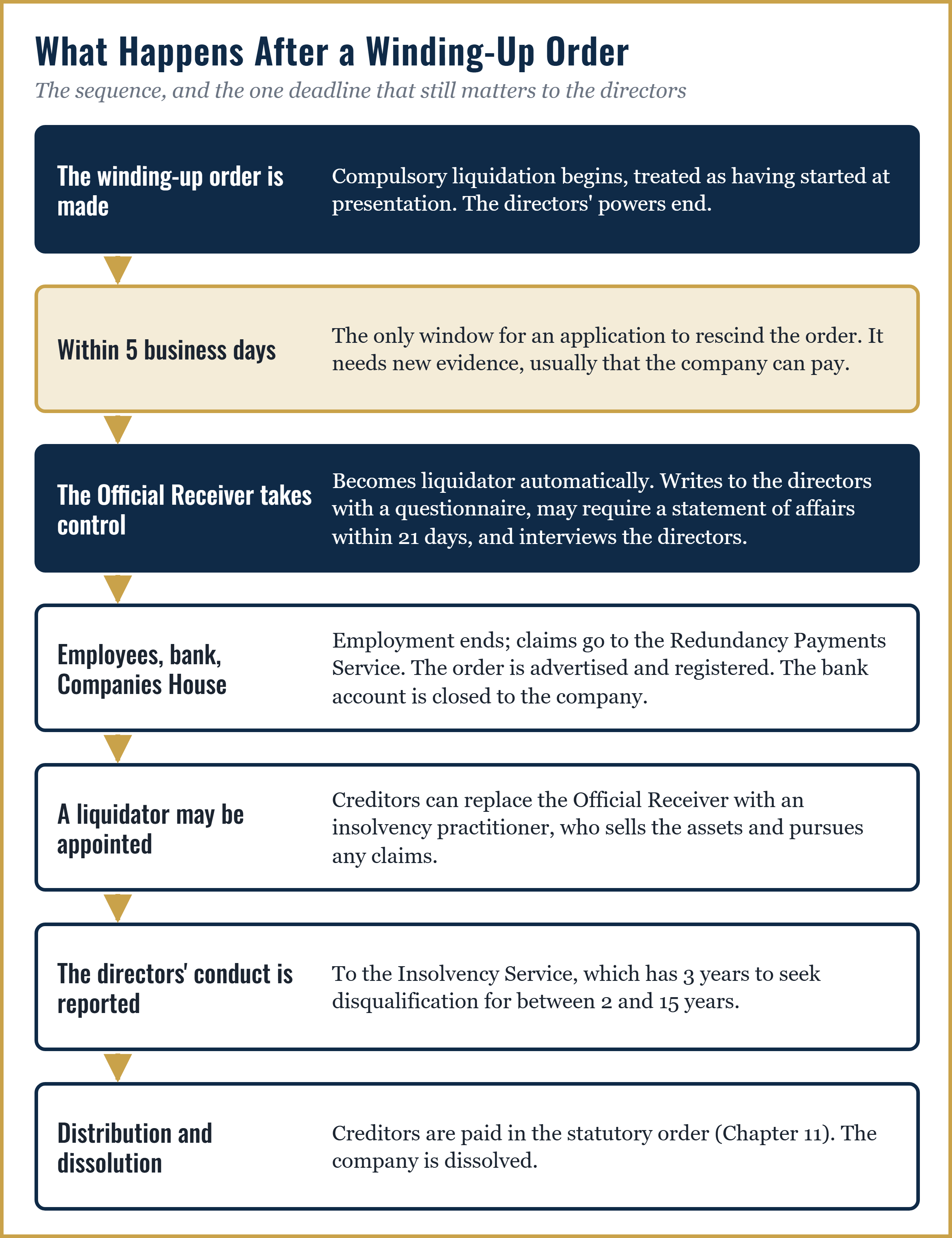 From The Winding-Up Petition Handbook, free for directors.
Key points
- A creditor, a shareholder or the Official Receiver can petition against a company already in MVL.
- A creditor of a solvent company in MVL should be paid in full with statutory interest, so the court needs a good reason to make an order.
- If the company cannot pay in full within the period declared, the MVL becomes a creditors' voluntary liquidation.
- Making a declaration of solvency without reasonable grounds is a criminal offence.
- If an order is made, the Official Receiver takes over and investigates.
Frequently asked questions
Can HMRC wind up a company in MVL? Yes. HMRC can petition like any creditor, but if the company can pay its tax in full the liquidator will normally pay it and the petition should not be needed.
What happens if a creditor appears after the MVL starts? It proves its debt to the liquidator and should be paid in full with statutory interest; if the company cannot pay everyone in full, the MVL converts to a creditors' voluntary liquidation.
What if the declaration of solvency was wrong? The liquidator must tell the creditors and the liquidation continues as a creditors' voluntary liquidation; the directors who made the declaration may face questions about whether they had reasonable grounds.
Can a liquidator in an MVL reject my creditor's claim? Yes, and the creditor can apply to the court to reverse that decision; a petition is not usually the right route for a disputed claim.
Free initial consultation for directors facing a winding-up petition. Call 07361 999123, text DIRAID to 82228, or request a call back.