
Yes. A voluntary liquidation does not stop a creditor asking the court to wind the company up (section 116 Insolvency Act 1986). But the court will not usually replace a voluntary liquidation chosen by the creditors unless the petitioner shows a good reason, most often that an independent investigation by the Official Receiver is needed. If an order is made, the Official Receiver takes over. Directors also ask "can HMRC wind up a company that is already in liquidation?", "why would a creditor petition when we are already in a CVL?" and "can a CVL be converted into a compulsory liquidation?". This page explains the test, what changes, and what it means for you.
Petition against a company already in liquidation? Free initial consultation with a Solicitor: call 07361 999123 or text DIRAID to 82228.
Your free call is with a Solicitor. Have the petition to hand if you can.
Text DIRAID to 82228and we will call you back
Or call us on 07361 999123
First consultation free · No obligation · Nothing to lose
Two different situations
This page is about a petition presented after the shareholders have passed the resolution to wind up and a liquidator is in office. The opposite case, where a petition is already pending and the directors want to put the company into voluntary liquidation before the hearing, is covered in can I liquidate after a winding-up petition?. The two raise different questions, and the dates matter: check whether the resolution or the petition came first.
Who can petition, and the test
| Petitioner | Can it petition? | What the court must be satisfied of |
|---|---|---|
| A creditor | Yes (section 116) | That there is a good reason to prefer a compulsory liquidation. The court looks at the wishes of the creditors as a whole, and the reasons the petitioner gives. |
| A shareholder (contributory) | Yes (section 116) | That the shareholders' rights will be prejudiced by the voluntary liquidation continuing. |
| The Official Receiver | Yes (section 124(5)) | That the voluntary liquidation cannot be continued with due regard to the interests of the creditors or contributories. |
A creditor petitioning against a company in CVL still has to be a creditor with standing and show the company is unable to pay its debts, but a company in CVL has usually declared that already through the directors' statement of affairs. The debt must be more than £750, as for any creditor's petition. A copy of the petition also has to be sent to the voluntary liquidator, who will normally deal with it for the company.
Why a creditor would do this
A creditor already has a liquidator in place, so a petition costs it time and money. In practice petitions against companies in CVL come from creditors, often HMRC, that are not content to leave the investigation to the liquidator the directors chose. The usual reasons are:
- Independence. The liquidator was introduced by the directors, and the creditor doubts that the liquidator will investigate them or pursue claims against them.
- Transactions before the liquidation. Assets or the business were moved to a connected company shortly before the resolution, or creditors connected with the directors were paid.
- The conduct of the CVL itself. The creditors' decision on the liquidator was not properly taken, or the liquidator's fees or dealings with the directors are questioned.
- An investigation with official powers. The Official Receiver investigates the causes of failure in every compulsory liquidation and can apply for a public examination of the directors.
The court gives weight to what the creditors as a whole want, usually measured by value, but it can give less weight to creditors connected with the directors or the company. A creditor that holds a large part of the independent debt and has a credible reason is in a stronger position than one acting alone on a small debt. The voluntary liquidator can put evidence before the court, but is not expected to take sides in a contest between creditors.
What happens if a winding-up order is made
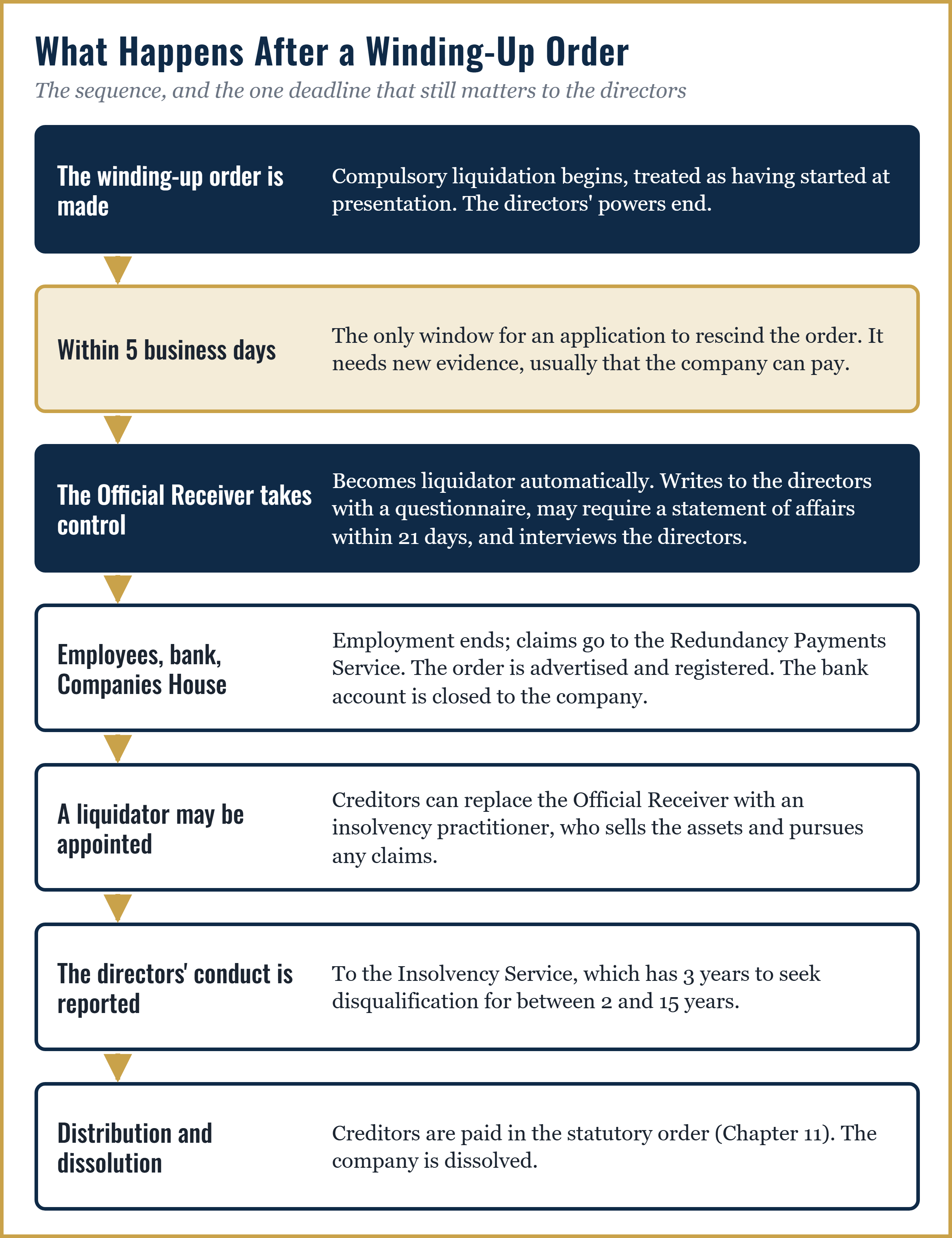
- The Official Receiver becomes liquidator. The voluntary liquidator leaves office and hands over the company's records, assets and money. The creditors can later decide whether to replace the Official Receiver with a private insolvency practitioner.
- The liquidation is treated as one continuous winding up. It is deemed to have started on the date of the resolution, not the date of the order (section 129(1)). The periods for looking back at preferences and transactions at an undervalue run from that date.
- What the voluntary liquidator did is normally valid. Steps taken in the voluntary liquidation are treated as validly taken unless the court, on proof of fraud or mistake, directs otherwise.
- A fresh investigation. The Official Receiver reviews the company's affairs, the directors' conduct before and during the liquidation, and the voluntary liquidator's work and fees.
If the court is not persuaded, it dismisses the petition and the voluntary liquidation continues. It can also adjourn, for example to let the creditors express their views. See what happens at the hearing.
What it means for you as a director
Once the company is in CVL, the directors' powers have ceased except so far as the liquidator or the creditors sanction them (section 103). You do not instruct lawyers for the company or decide whether to oppose: the liquidator does. But a petition of this kind is very often about the directors, so it matters to you personally.
- Expect a closer look. The Official Receiver will want the books and records, an explanation of the company's last months and the reasons for its failure, and may ask you to attend an interview. You must co-operate (section 235).
- Transactions will be looked at again. Payments to you or to connected creditors, an overdrawn director's loan account, and any sale of the business or assets to a connected company. See what happens to directors in liquidation and defending a liquidator's claim.
- Disqualification. The office-holder's report on the directors' conduct goes to the Insolvency Service in either kind of liquidation. A compulsory liquidation does not of itself mean disqualification, but it does mean the conduct is reviewed by an official investigator. See can I be disqualified after liquidation? and Insolvency Service investigation: what to do.
- Personal guarantees and tax. These do not change with the type of liquidation. See director liability after a winding-up petition.
DO NOT ignore letters from the Official Receiver or the petitioner's solicitors, and DO NOT move or destroy company records once you learn of the petition. A director who co-operates fully and early is in a better position in any later investigation.
DO NOT assume the petition will fail because a liquidator is already in place. Courts do make orders against companies in CVL where the creditors have a credible reason.
Can you prevent it?
Often the best protection is the way the CVL was set up. A liquidator with no connection to you, a properly run creditors' decision, a full statement of affairs and a clear account of what happened to the assets before the resolution all reduce a creditor's reasons to petition. If a creditor raises concerns, the liquidator can sometimes meet them, for example by agreeing to investigate a particular transaction. If you are choosing a liquidator now, see choosing a liquidator: the questions to ask and how to put a company into creditors' voluntary liquidation.
Creditors' voluntary liquidation is by far the most common insolvency procedure: about 1,488 companies a month had a liquidator appointed in a CVL in the twelve months to October 2026, against far fewer winding-up orders (how many companies go into CVL each month?). A petition against a company already in CVL is unusual, which is why it is a strong signal that a creditor has concerns.
 From The Winding-Up Petition Handbook, free for directors.
Key points
- A voluntary liquidation does not bar a creditor's or shareholder's petition (section 116); the Official Receiver can petition too (section 124(5)).
- The court does not lightly replace a CVL: the petitioner needs a good reason, and the court weighs the wishes of independent creditors.
- The usual reasons are doubts about the liquidator's independence, transactions before the liquidation, and the need for an official investigation.
- If an order is made, the Official Receiver becomes liquidator and the winding up is treated as starting on the date of the resolution.
- The directors no longer control the company's response, but the petition is often about their conduct: co-operate and take advice.
Frequently asked questions
Can HMRC wind up a company that is already in liquidation? Yes. HMRC, like any creditor, can petition against a company in creditors' voluntary liquidation, but the court will make an order only if there is a good reason to prefer a compulsory liquidation.
Can a CVL be converted into a compulsory liquidation? Yes, by a winding-up order on a petition. The Official Receiver then becomes liquidator and the winding up is treated as having started on the date of the resolution.
Who responds to the petition for the company? The voluntary liquidator, because the directors' powers end when the company goes into CVL. Directors can give information and evidence, and should take their own advice if their conduct is in issue.
Will a compulsory order make disqualification more likely? Not by itself. The directors' conduct is reported on in either kind of liquidation, but a compulsory order brings an investigation by the Official Receiver.
Free initial consultation for directors facing a winding-up petition. Call 07361 999123, text DIRAID to 82228, or request a call back.