
Yes. A company incorporated outside the UK can be wound up by the English court as an "unregistered company" under Part V of the Insolvency Act 1986, usually because it cannot pay a debt owed here. The court must be satisfied that the company has a sufficient connection with England and Wales and that a winding up here would benefit the creditors. Directors also ask "can a UK creditor wind up an overseas company?", "can HMRC petition against a non-UK company?" and "does registering as an overseas company at Companies House make a difference?". This page explains the grounds, the procedure, and what it means for you.
Petition against an overseas company? Free initial consultation with a Solicitor: call 07361 999123 or text DIRAID to 82228.
Your free call is with a Solicitor. Have the petition to hand if you can.
Text DIRAID to 82228and we will call you back
Or call us on 07361 999123
First consultation free · No obligation · Nothing to lose
Which companies this covers
Part V applies to any company or association except a company registered under the Companies Act 2006 in any part of the UK (section 220). In practice it covers:
- a company incorporated abroad that trades in England and Wales through a branch, an office or staff here, including one registered at Companies House as an overseas company with a UK establishment;
- a company incorporated abroad with no establishment here but with other links: customers, contracts, property, employees or creditors in England and Wales;
- a company incorporated abroad that has stopped trading here, or has even been dissolved in its home country (section 225).
A company registered in Scotland or Northern Ireland is not an unregistered company. It is registered under the Companies Act 2006, and its winding up is a matter for the courts of the part of the UK where it is registered, so this page does not apply to it.
The grounds
The court can wind up an unregistered company on any of three grounds (section 221(5)):
- it has been dissolved, has ceased to carry on business, or is carrying on business only to wind up its affairs;
- it is unable to pay its debts; or
- the court thinks it just and equitable to wind it up.
Nearly all creditors' petitions rely on the second ground, as they do against English companies.
How a creditor shows the company cannot pay
| Route | What the creditor must show |
|---|---|
| Written demand (section 222) | It is owed more than £750, then due, and served a written demand in the prescribed form by leaving it at the company's principal place of business, by delivering it to the secretary or a director, manager or principal officer, or in another way the court approves; and the company has not paid, secured or compounded the debt to the creditor's satisfaction within three weeks |
| Unsatisfied judgment (section 224(1)(a)) | Enforcement of a judgment against the company has been returned unsatisfied |
| Cash flow (section 224(1)(d)) | It is otherwise proved to the court that the company cannot pay its debts as they fall due, for example an undisputed debt left unpaid after a clear demand |
| Balance sheet (section 224(2)) | The company's assets are worth less than its liabilities, taking account of contingent and prospective liabilities |
The demand is the equivalent of a statutory demand against an English company, but it is served at the principal place of business, not a registered office. For the purposes of the winding up, the company's principal place of business in England and Wales is treated as its registered office (section 221(3)). A company that has its only principal place of business in Northern Ireland cannot be wound up under Part V unless it also has one in Great Britain.
The connection the court needs
Because the company belongs to another country, the court does not wind it up simply because it has a creditor here. The court looks for:
- a sufficient connection with England and Wales. A place of business, assets, trading, employees or contracts governed by English law will usually be enough; the company does not have to have assets here;
- a reasonable possibility of benefit to those applying for the order, for example a liquidator who can investigate, pursue claims or recover assets, or employees who can claim from the National Insurance Fund; and
- one or more people interested in the distribution of the company's assets over whom the court can exercise jurisdiction.
The court will also consider whether insolvency proceedings in the country of incorporation would be more appropriate. If proceedings have already been opened abroad, the foreign office-holder can apply to have them recognised in Great Britain under the Cross-Border Insolvency Regulations 2006, which can stay actions against the company here and changes what the English court is likely to do. Since the end of the Brexit transition period the EU rules on where insolvency proceedings must be opened no longer apply to new cases in England and Wales.
What is the same as for an English company
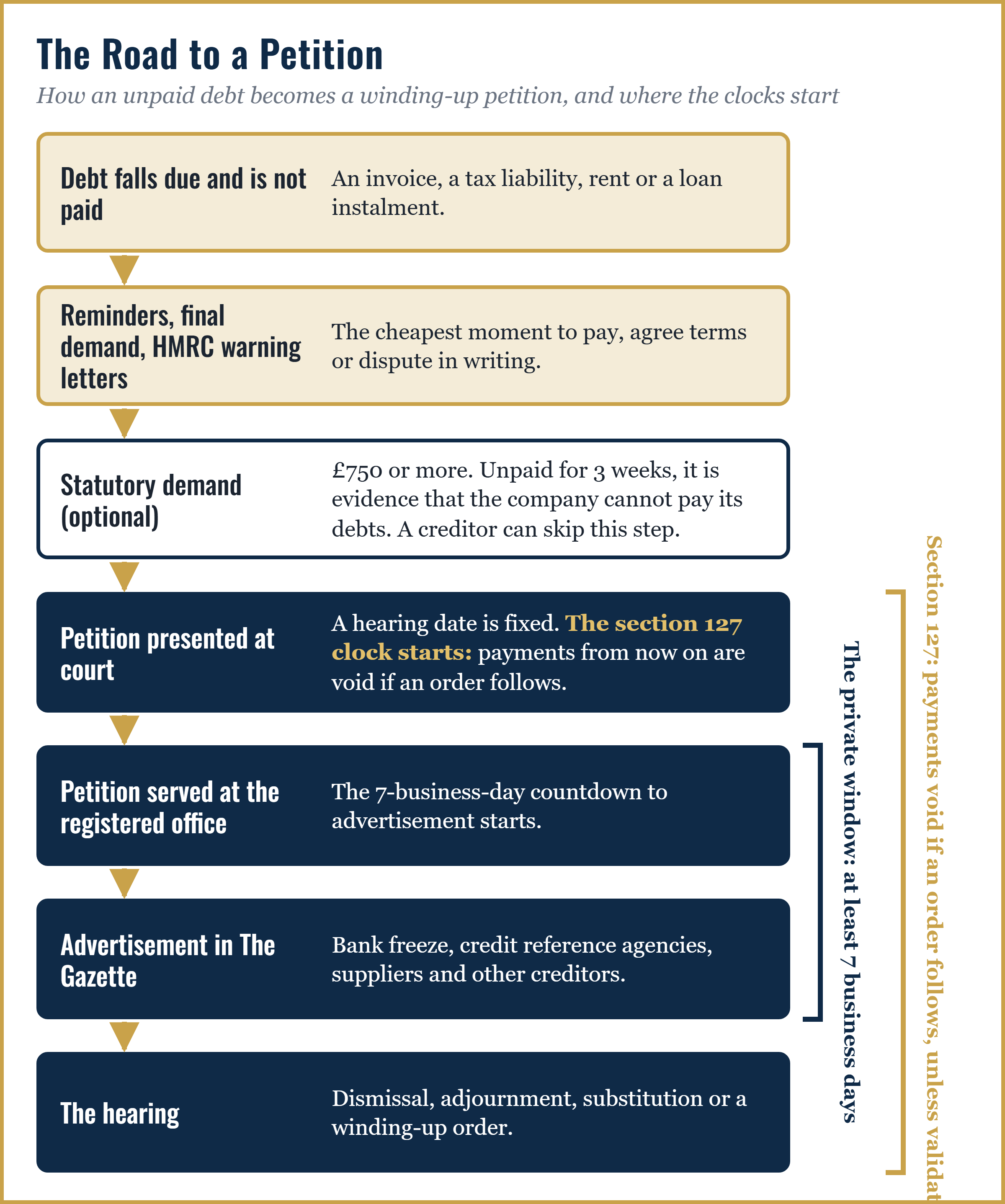
Once a petition is presented, the procedure is very close to a petition against an English company: service, advertisement in the Gazette no earlier than 7 business days after service and no later than 7 business days before the hearing, evidence in opposition at least 5 business days before the hearing, and a hearing at which the court can dismiss, adjourn or make an order. Dispositions of the company's property after presentation are void if an order follows unless the court validates them (section 127), so a UK bank that learns of the petition is likely to freeze the company's accounts here. See winding-up petition: bank account frozen, the deadline calculator and what happens at the hearing.
The usual answers are also the same: a genuine dispute on substantial grounds, a cross-claim, payment, or an agreement with the petitioner. For a foreign company there is one more: that the court should not take jurisdiction because the connection or the benefit is missing. See disputed debt and a winding-up petition and how to stop a winding-up petition.
What is different
- No voluntary liquidation here. An unregistered company cannot generally be wound up voluntarily under the Insolvency Act 1986 (section 221(4)), so the directors cannot simply put it into a creditors' voluntary liquidation in England to forestall the petition. The company's home law may offer its own procedures.
- Rescue procedures depend on the company. Administration and other procedures can be available to some overseas companies, but whether they are depends on where the company is incorporated and where its centre of main interests is. Take advice before relying on one.
- Contributories. Anyone liable to contribute to the company's debts is a contributory (section 226), and once an order is made, proceedings against a contributory for a company debt need the court's permission (section 228).
What it means for you as a director
If an order is made, the Official Receiver becomes liquidator of the company in England and Wales and investigates its affairs here. The directors are in broadly the same position as directors of an English company: they must co-operate with the liquidator, provide the books and records, and can face claims for wrongful trading, misfeasance, preferences and transactions at an undervalue. The disqualification legislation applies to directors of companies that can be wound up under Part V, so a director can be disqualified from acting for companies in Great Britain. Personal guarantees and any personal tax liabilities are unaffected by the company's place of incorporation. See director liability after a winding-up petition and can I be disqualified after liquidation?.
DO NOT move money or assets out of England and Wales once a petition is threatened or presented. A transfer made to put assets beyond the reach of creditors here can be reversed and can lead to personal claims and disqualification.
DO NOT ignore a demand because the company is registered abroad. If the court has jurisdiction, the timetable runs as it would against an English company.
 From The Winding-Up Petition Handbook, free for directors.
What to do now
- Find out exactly what has been served, where and on whom, and the hearing date.
- Check whether the company is registered at Companies House as an overseas company and what its UK establishment is.
- Work out whether the debt is disputed and whether the company can pay or secure it.
- Take advice in England and in the country of incorporation at the same time: the two may affect each other.
- Speak to the company's UK bank before it freezes the accounts, and ask about a validation order if trading must continue.
Key points
- A company incorporated abroad can be wound up in England and Wales as an unregistered company under Part V Insolvency Act 1986.
- The grounds are dissolution or ceasing business, inability to pay debts, or that winding up is just and equitable.
- A creditor owed more than £750 can serve a written demand at the company's principal place of business; three weeks unpaid shows the company cannot pay.
- The court needs a sufficient connection with England and Wales and a reasonable possibility of benefit before it will make an order.
- Companies registered in Scotland or Northern Ireland are outside Part V; their own courts deal with them.
Frequently asked questions
Can a UK creditor wind up an overseas company? Yes, if the company owes it money it cannot pay and the company has a sufficient connection with England and Wales, such as a place of business, assets or trading here.
Can HMRC petition against a company registered abroad? Yes. HMRC can petition like any other creditor for unpaid UK taxes, and the same test of connection and benefit applies.
Does the company need assets in England for the court to wind it up? No. Assets here help, but the court can make an order without them if there is a sufficient connection and a reasonable possibility of benefit.
Can the directors put a foreign company into voluntary liquidation in England instead? Generally not. An unregistered company cannot be wound up voluntarily under the Insolvency Act 1986, though its home country's law may offer other procedures.
Free initial consultation for directors facing a winding-up petition. Call 07361 999123, text DIRAID to 82228, or request a call back.